
CNC Machine Maintenance Checklist: Daily, Weekly and Yearly
What should you check on a CNC machine every day, week, month and year? Lubrication, coolant, axis backlash, filters, and why the manufacturer's manual comes first.
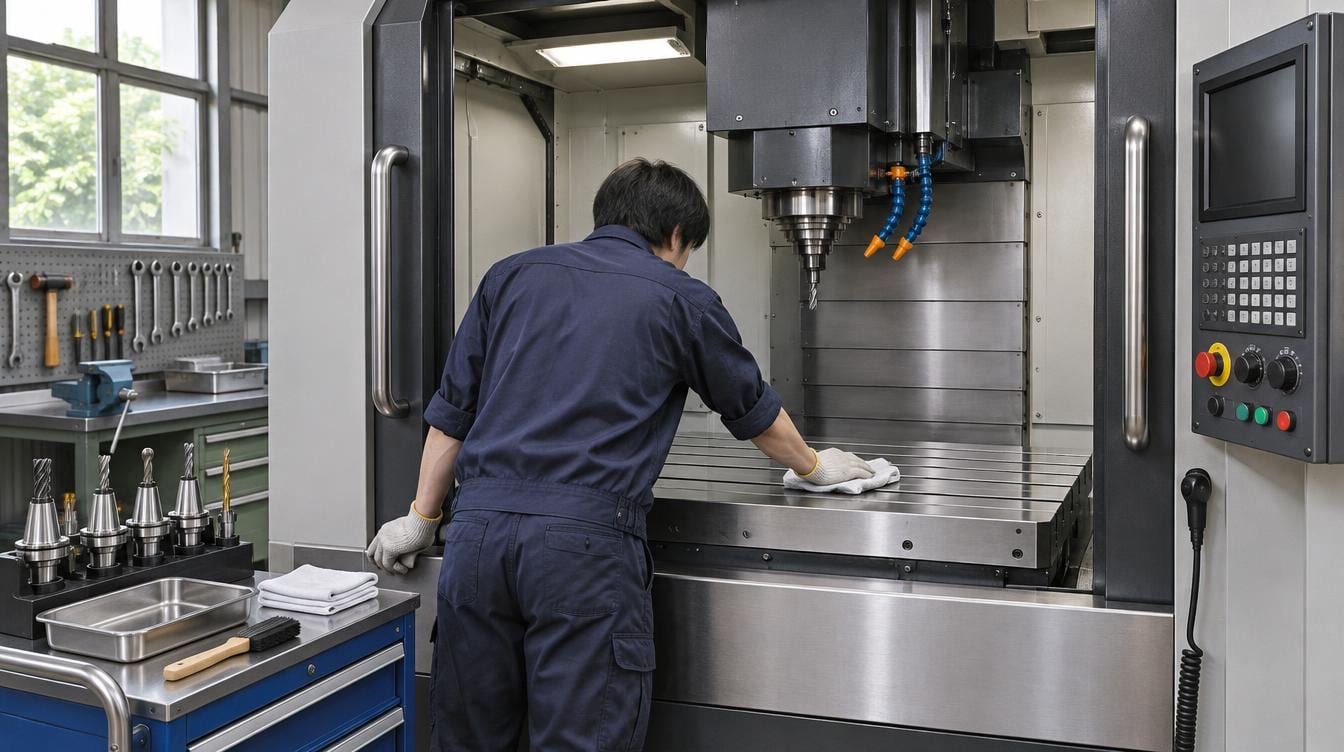
Who sets the maintenance intervals?
The manufacturer that designed the machine knows best when and with what it should be serviced. Oil grades, lubrication points, filter change intervals and the safety devices to be checked differ from model to model. The list in this article is a general framework; where it conflicts with your machine's manual, the manual wins.
Turkish law takes the same approach. The Regulation on Health and Safety Conditions for the Use of Work Equipment (İş Ekipmanlarının Kullanımında Sağlık ve Güvenlik Şartları Yönetmeliği) requires equipment to be maintained according to the criteria and intervals set by the relevant standards and the manufacturer, and all maintenance and repairs to be recorded and kept for the life of the equipment (Annex III, 1.3.3 and 1.3.4). The same annex also requires operators to check the equipment before each start of work.
Usage changes the intervals. A machine running three shifts is not serviced on the same calendar as one used a few days a week. Manual intervals are usually given for a defined duty cycle; if your machine works harder, check more often.
What should be checked at the start of every shift?
Daily checks take a few minutes but catch most problems early. Before starting the machine, go through the following items.
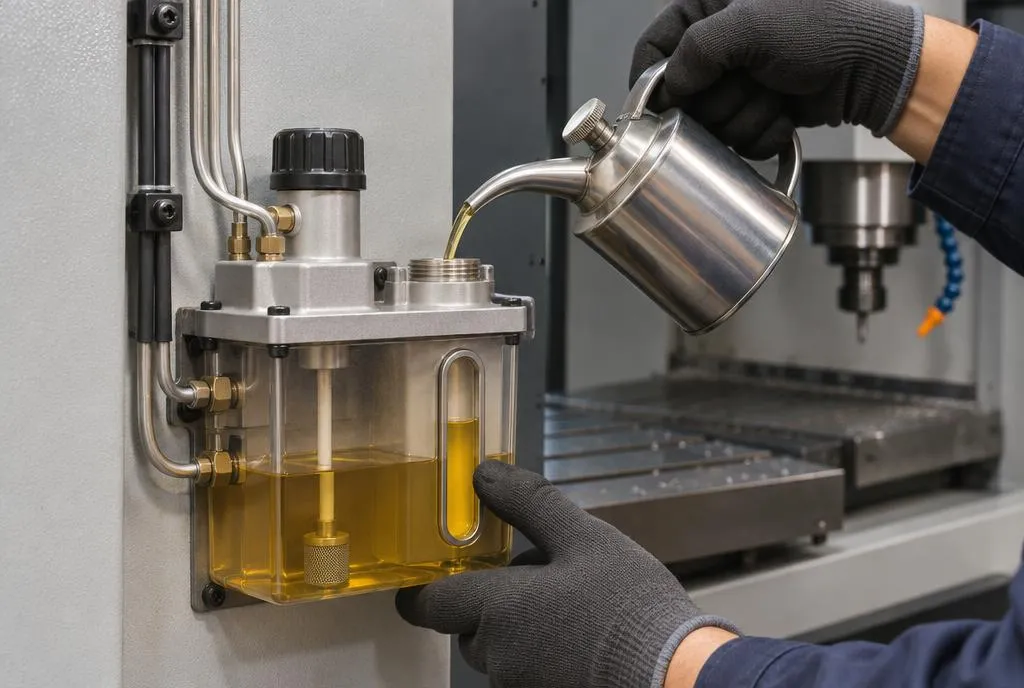
- Chip cleaning: Remove chips from the way covers (telescopic covers protecting the axis guideways) and the table. The manufacturer manual we refer to recommends a chip brush; compressed air can drive chips between the way cover segments and can throw them towards the eyes.
- Way oil level: Check the level in the central lubrication tank and top up with the oil specified by the manufacturer.
- Coolant level and appearance: Check level, colour and smell. An unusual odour can be a sign of bacterial growth.
- Door interlock: Confirm that the door switch works and that machining does not start with the door open.
- Air and hydraulics: Where fitted, check the pressure and water drain on the air service unit and the oil level in the hydraulic unit.
- Noise and alarms: When the machine is first started, listen for unusual noise or vibration and look for alarms.
What do weekly and monthly checks cover?
Weekly and monthly tasks catch slow changes that daily checks miss. The table below summarises a distribution commonly found in manufacturer manuals; the exact interval is in your machine's manual.
| Interval | Check | Purpose |
|---|---|---|
| Daily | Chip cleaning, way oil level, coolant level, door interlock | Prevent dry running and way cover damage |
| Weekly | Coolant concentration and pH, oil reaching lubrication points, condition of guards | Tool life, surface finish, corrosion |
| Monthly | Electrical cabinet ventilation, fine swarf in the coolant tank, oil film on ways and ball screws | Overheating, filter clogging, wear |
| Six-monthly | Way covers, lubrication hoses, limit switches, spindle belt | Leaks, axis faults, unplanned stops |
| Yearly | Accuracy measurement, oil and filter changes specified by the manufacturer, electrical inspection | Keep dimensional accuracy and safety |
Check separately that oil actually reaches the lubrication points. A falling tank level does not prove that oil is reaching the ways; a blocked hose or distributor can leave one axis dry. At the monthly check you should see a thin oil film on the guideways and on the ball screws (the precision screw-and-nut assemblies that drive the axes).
The ventilation grilles and filters of the electrical cabinet are often forgotten. A filter clogged with dust can cause the drives inside the cabinet to overheat and trigger intermittent alarms.
How should coolant be monitored?
Water-mix cutting fluid (soluble oil emulsion) deteriorates in the machine over time. If concentration, pH and tramp oil (way, hydraulic or gearbox oil that leaks into the tank) are not monitored, tool life drops, parts and machine rust, and a health risk develops.
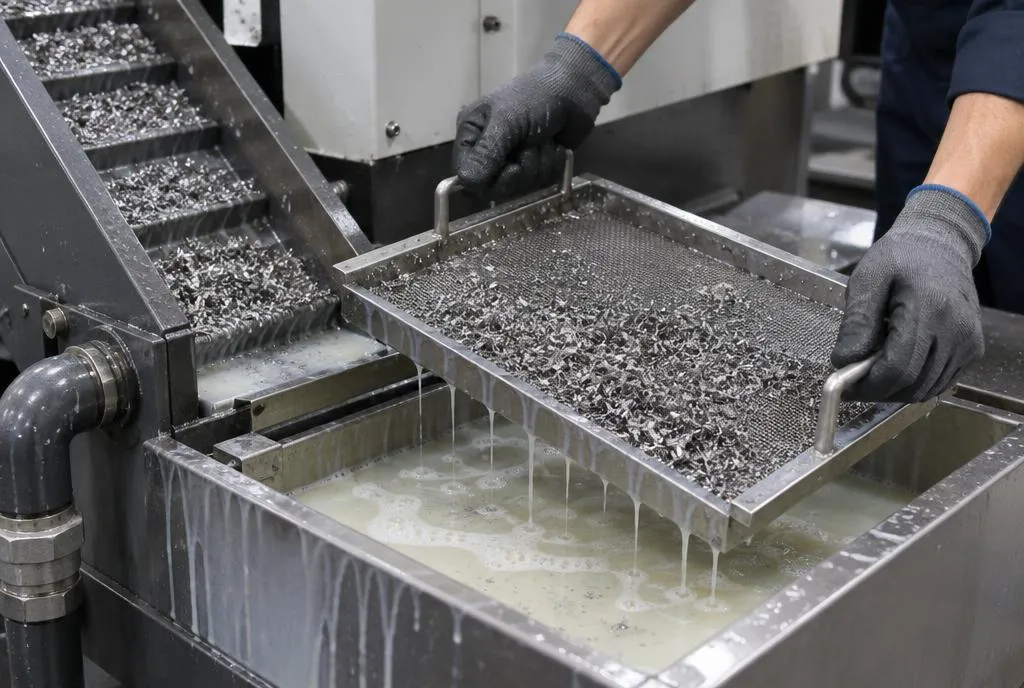
The UK Health and Safety Executive's MW5 guidance recommends the following:
- Measure concentration with a refractometer and pH every week, using the target values given by your fluid supplier. Mobil's technical note recommends checking concentration at the start of every day or shift.
- Look at the fluid every day; an unusual odour or biofilm (a bacterial layer) on tank surfaces is a warning sign.
- Check tramp oil weekly; HSE recommends keeping it below 2%. Remove it with skimmers or similar systems.
- Test for bacteria with a dipslide once a week. A result of 10⁴ cfu/ml or above indicates microbial growth, and 10⁶ cfu/ml or above indicates poor control, which normally means draining and cleaning the system.
As water evaporates, the emulsion becomes more concentrated. For this reason the tank is topped up not with plain water but with a mix below the recommended concentration.
HSE notes that inhaling metalworking fluid mist can cause lung diseases such as occupational asthma and hypersensitivity pneumonitis, and that skin contact can cause dermatitis. Fluid maintenance is therefore an occupational health issue, not only a matter of part quality.
How do you keep track of axis backlash and guideways?
Backlash is the small lost motion that appears when an axis reverses direction, caused by wear in the screw-and-nut or bearing assembly. On the part it shows up as marks at the reversal points of circular contours, or as dimensions that depend on the direction of travel.
Two things help detect it early:
- Way covers and wipers: A torn way cover or worn wiper lets chips and coolant reach the guideways. The manufacturer manual we refer to recommends removing the way covers every six months and cleaning out chips and oil underneath.
- Periodic accuracy testing: A ballbar measures tiny variations in radius while the machine follows a programmed circular path, revealing geometric, dynamic and play-related errors. Results can be reported to international standards such as ISO 230-4. Repeating the same test at regular intervals and comparing results shows wear before parts are scrapped.
When backlash increases, the decision between adjustment and part replacement should be made with the manufacturer or an authorised service.
What is done at six-monthly and yearly maintenance?
Longer-interval maintenance usually means taking the machine out of production for a while, so it should be planned ahead. One manufacturer's six-monthly list includes the spindle belt, way covers, the axis cable carrier, checking the lubrication system for blockages, lubrication hoses and verifying the limit switches.
In most shops yearly maintenance is done together with an authorised service: oil and filter changes specified by the manufacturer, fully draining and cleaning the coolant tank, checking electrical connections, and measuring accuracy. Clean fluid should never go into a dirty machine; Mobil's technical note recommends cleaning the system with a cleaner and flushing it before refilling with fresh emulsion.
You can see the CNC vertical machining, milling and turning machines in our workshop on our About page. For the differences between machine types, read our article CNC Milling vs CNC Turning.
Why do safety and records matter during maintenance?
The regulation is clear: maintenance may only be carried out when the equipment is switched off, disconnected from its energy supply, with all movement stopped and not running; where this is not possible, the necessary precautions must be taken or the work done outside the danger zone (Annex I, 2.13).
Record every maintenance task with the date, the person who did it and the findings. The regulation requires maintenance on machines with a maintenance logbook to be entered in the logbook on the same day (Annex I, 2.13.1). Which equipment is subject to statutory periodic inspection is determined by the tables in Annex III; ask your occupational safety specialist about your machines.
Sources
Frequently asked questions
Who sets maintenance intervals for a CNC machine?
Primarily the machine manufacturer. Turkish work equipment regulations also require maintenance to follow the criteria and intervals set by the relevant standards and the manufacturer. Machines in heavy use need more frequent checks.
How often should coolant concentration be measured?
HSE's MW5 guidance recommends measuring concentration with a refractometer and pH every week, while Mobil's technical note recommends checking concentration at the start of every day or shift. Target values come from the fluid supplier.
Is it fine to clean chips with compressed air?
The manufacturer manual we refer to recommends a chip brush. Compressed air can drive chips between the way cover segments and throw them towards the eyes. Cleaning should be done with the machine stopped.
How can I tell if an axis has backlash?
You may see marks at the reversal points of circular contours, or dimensions that change with the direction of travel. A circular test with a device such as a ballbar, repeated at regular intervals, shows backlash and other errors in numbers.
Are maintenance records mandatory in Turkey?
Annex III of the work equipment regulation requires all maintenance and repairs to be recorded and kept for the life of the equipment. Ask your occupational safety specialist for details.
This article is for general information only. Make decisions on machine selection, safety and design together with the relevant engineer and manufacturer.