CNC Milling vs CNC Turning: Which Part Goes on Which Machine?
On a lathe the workpiece rotates; on a milling machine the cutter rotates. We compare the axes, typical operations and the parts each machine is best suited to, with practical examples.
What rotates in turning and in milling?
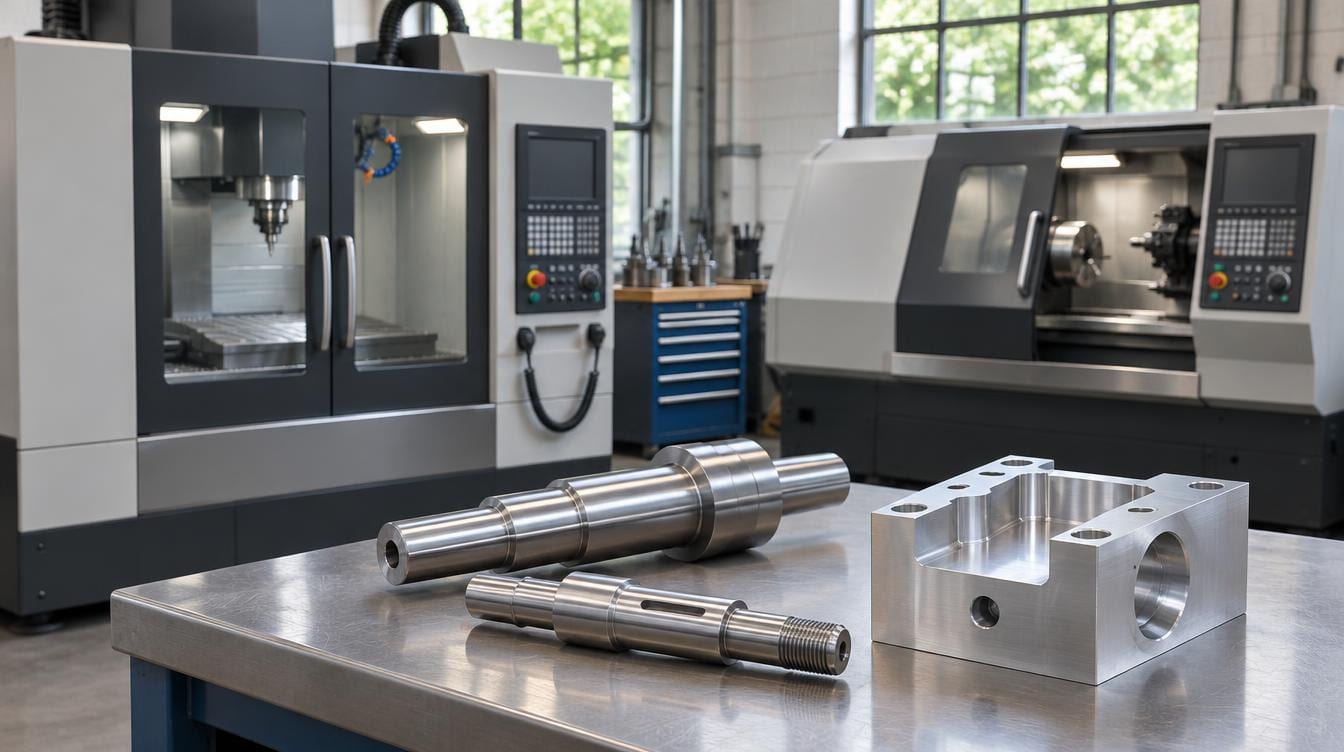
The key difference is which element produces the cutting motion. In turning, the workpiece is held in a chuck and rotated; the cutting tool is held almost stationary and fed parallel or perpendicular to the axis of rotation. A single-point tool removes material from the rotating part and produces cylindrical, tapered or profiled surfaces.
Milling uses a rotary cutter. A face mill or end mill spins on its own axis, the part is clamped on the table or in a vise, and the tool is usually fed perpendicular to its axis. This produces flat faces, pockets, slots and holes.
The nature of the cut also differs. In milling, each cutting edge repeatedly enters and leaves the material, which is called intermittent cutting. Sandvik Coromant notes that, because of intermittent cutting, milling is a much cooler operation than turning. In turning, the cutting edge is usually in continuous contact with the material.
How are the axes defined?
A CNC lathe has two basic linear axes: Z along the spindle axis and X across the diameter. The programmer defines the length of the part with Z and its diameter with X. On a vertical machining center (CNC mill), X and Y are movements in the table plane and Z is the up-and-down movement of the spindle. Mills fitted with a rotary table or rotary axis add a fourth and fifth axis.
Which operations are done on a CNC lathe?
Most lathe work produces surfaces that are symmetrical about the axis of rotation. The tool is selected from the turret and approaches the part in the programmed sequence.
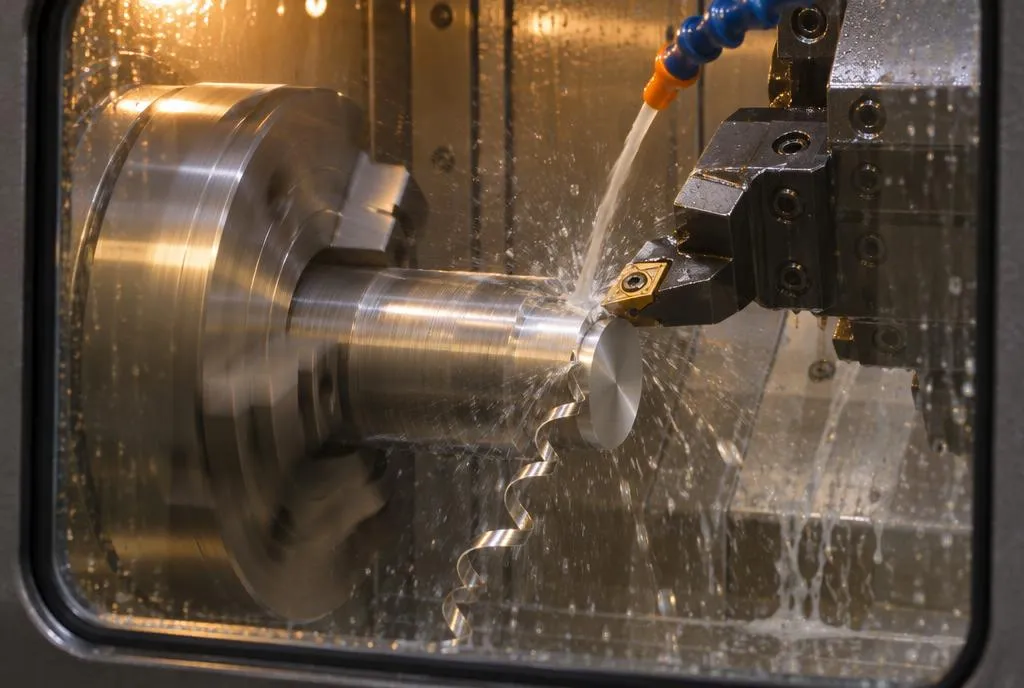
Typical turning operations are:
- Facing: the tool moves perpendicular to the axis of rotation to flatten the end face of the part.
- OD and taper turning: the tool moves parallel or at an angle to the axis to produce diameters and tapers.
- Grooving: a groove of a set depth is cut, for example a retaining ring groove.
- Threading: external or internal threads are cut with a tool shaped to the thread profile.
- Boring: the inside surface of an existing hole or tube is machined to correct its diameter and finish.
- Drilling: the drill stays stationary while the part rotates, so the hole is on the part centerline.
- Parting: a deep groove is cut until the finished part separates from the bar.
Which operations are done on a CNC mill?
Because the part is stationary, a mill can produce flat, angled or free-form geometry on any surface the tool can reach. Holes can be placed at any coordinate, not only on a centerline.
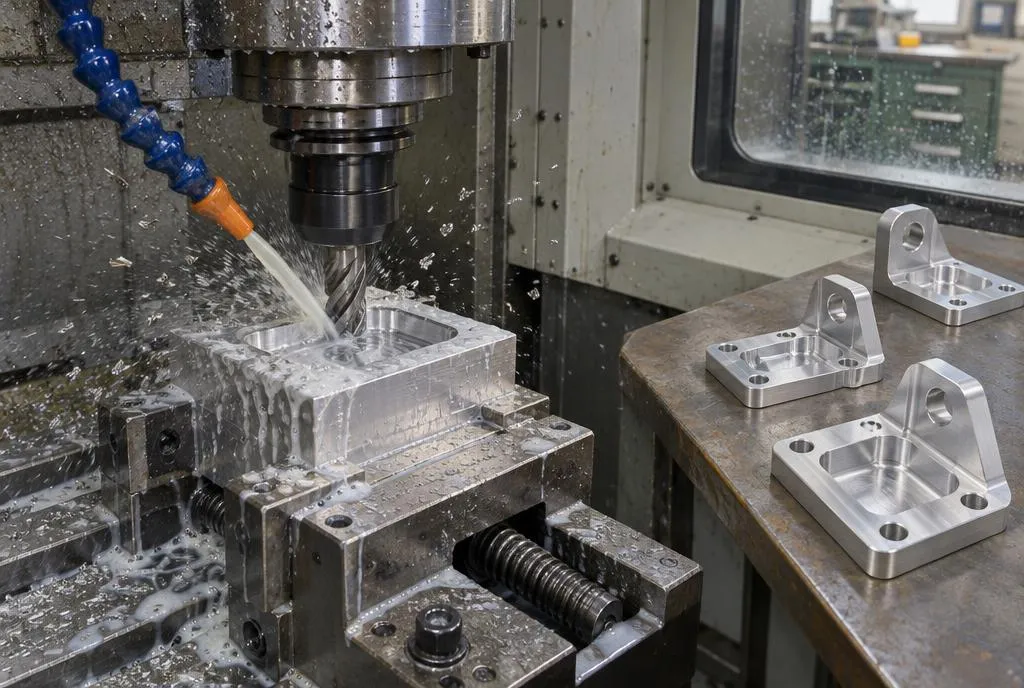
Typical milling operations are:
- Face milling: a large surface is flattened, with cutting done mainly by the corners at the end of the cutter.
- Peripheral milling and slotting: the side edges of the tool cut slots, keyways and steps.
- Pocketing: material inside a closed boundary is removed to a set depth, usually with a flat-bottom end mill.
- Drilling, tapping and boring: holes spread across the part can be machined in a single setup.
- Contouring and 3D surfacing: mold cavities and curved surfaces are machined with coordinated axis motion.
Workholding is another strength of the mill. Irregular parts can be clamped securely in a vise, a fixture or a custom jig. On the other hand, machining long, slender round parts on a mill is awkward and rarely economical.
Which part should be made on which machine?
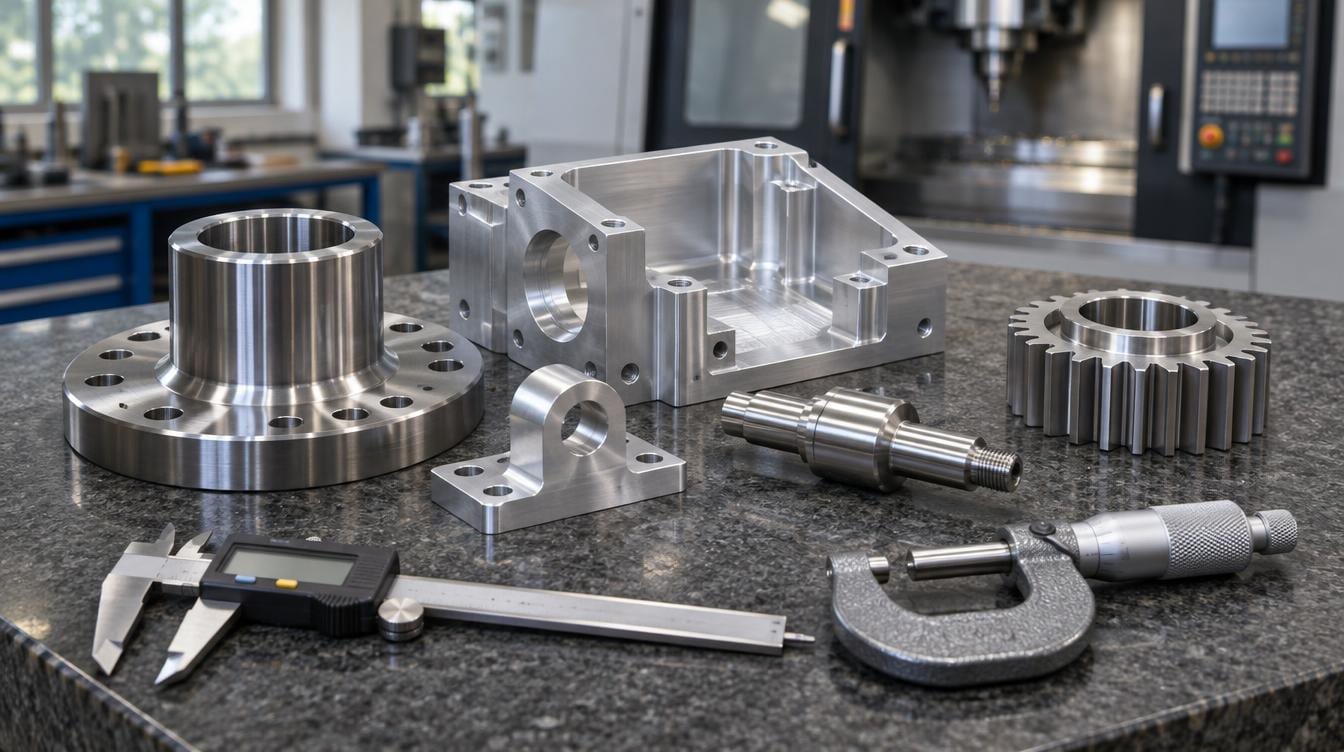
A simple rule: if the main geometry of the part revolves around an axis (cylinder, cone, ring), it goes on a lathe; if it consists of flat faces, corners and holes spread across the part, it goes on a mill. The table below is a general guide for parts commonly seen in a job shop.
| Part | Geometry | Suitable machine | Note |
|---|---|---|---|
| Shaft, axle, pin | Round | CNC lathe | A keyway needs an extra milling operation |
| Bushing, bearing housing, ring | Round, with bore | CNC lathe | The bore is finished by boring |
| Flange | Round | CNC lathe + mill | Bolt holes are made on a mill or with live tooling |
| Mounting plate, bracket | Prismatic | CNC mill | Pockets, slots and holes can be done in one setup |
| Mold plate, mold cavity | Prismatic, 3D surface | CNC mill | Curved surfaces need 3 or more axes |
| Machine housing, block | Prismatic | CNC mill | Several faces usually require re-clamping |
| Bolt, special fastener | Round | CNC lathe | The thread is cut on the lathe |
Real parts are often mixed. A shaft with a keyway and a cross hole, for example, is first turned to diameter and then moved to a mill for the keyway and holes. In this two-step route, every new setup means re-aligning the part, which affects both cycle time and accuracy.
What do mill-turn machines change?
Combining milling and turning on one machine began with live tooling on lathes. Live tooling means the tool in the turret is driven by its own motor, so drilling, tapping and light milling can be done while the part is still clamped on the lathe. The C axis indexes the spindle to a given angle or rotates it under control, and the Y axis lets the tool move off center. This makes it possible to machine eccentric holes, flats and off-center slots.
The next step is multitasking machines, built to perform turning and milling in the same work envelope. Sandvik Coromant defines turn milling as milling a curved surface while the workpiece rotates around its center point; complex profiles such as turbine blades need simultaneous motion in 4 or 5 axes in total, shared between the part and the tool.
The gain is that the part can be finished in one setup. They are not needed for every job, however. Y-axis travel and live tool power are limited and vary by model; for large pockets, heavy milling or prismatic parts with many faces, a separate machining center is often the better choice. Check the machine builder's technical data for the actual limits.
What should you prepare when requesting a quote?
The shop usually decides which machine a part goes on, but having some information clear from the start speeds things up:
- A dimensioned drawing or 3D model with critical tolerances
- Material grade and heat treatment condition, if any
- Quantity and repeat frequency (one-off, small batch, series)
- Surface finish, coating and assembly requirements
Our workshop in Bornova, Izmir, carries out CNC machining with vertical machining centers, milling machines and lathes. You can see examples of our work in the catalogue and request a quote for your part on the contact page.
Sources
Frequently asked questions
What is the main difference between CNC turning and CNC milling?
In turning the workpiece rotates and the tool feeds along the axis and across the diameter. In milling the cutter rotates and the part stays clamped on the table.
Can a square or rectangular part be machined on a lathe?
Some operations are possible with a four-jaw chuck or a special fixture, but prismatic parts are usually easier and more economical to machine on a mill.
Can a keyway be cut on a shaft using a lathe?
Not on a conventional lathe. The keyway is cut on a milling machine or on a mill-turn machine with live tooling.
Is a mill-turn machine always the better choice?
No. It is an advantage when a part can be finished in one setup, but Y-axis travel and live tool power are limited. Heavy milling and large prismatic parts suit a machining center better.
What information is needed for a machining quote?
A dimensioned drawing or 3D model, critical tolerances, material and heat treatment condition, quantity, and surface finish or coating requirements.
This article is for general information only. Make decisions on machine selection, safety and design together with the relevant engineer and manufacturer.