3D Printing or CNC Machining for Prototypes and Small Batches?
We compare 3D printing and CNC machining on tolerance, strength, materials, surface finish, quantity and lead time, and explain when each makes sense for prototypes and small batches.
What is the basic difference between 3D printing and CNC machining?
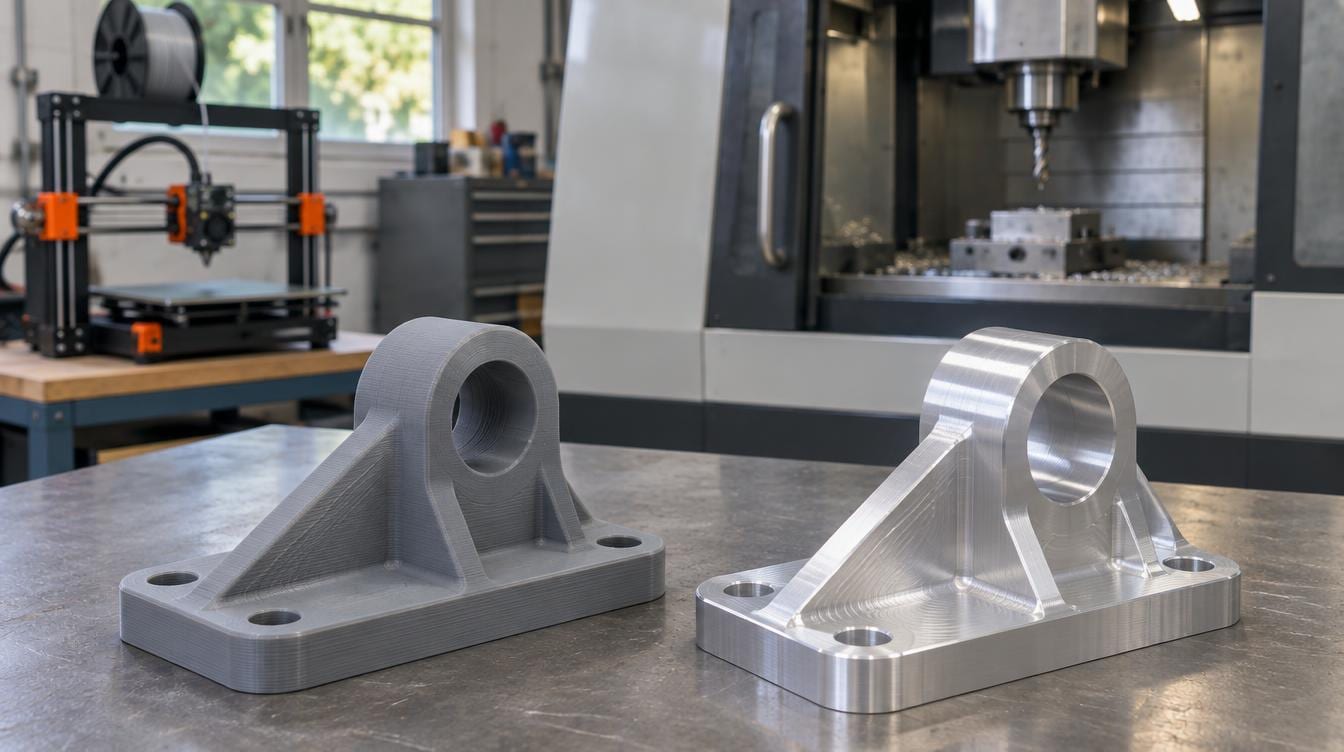
3D printing is an additive process: the part is built layer by layer from a digital model. CNC machining is a subtractive process: a solid block or bar is cut on a computer-controlled machine tool, and excess material is removed as chips.
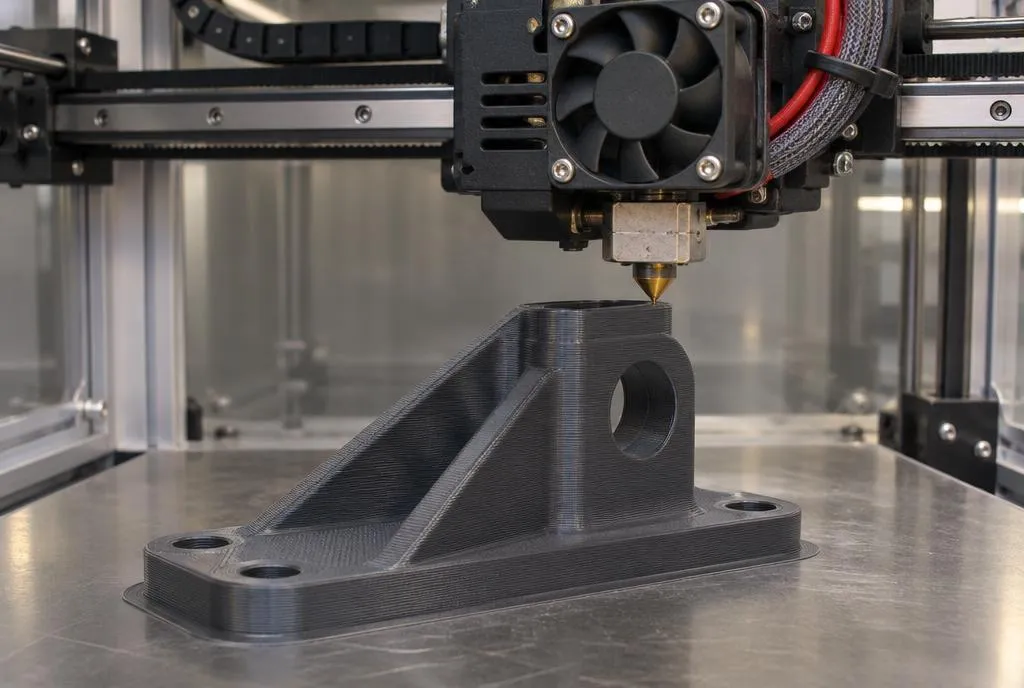
Three printing methods dominate plastic prototyping. FDM (fused deposition modelling) extrudes molten thermoplastic filament through a nozzle. SLA (stereolithography) cures liquid resin with light, layer by layer. SLS (selective laser sintering) fuses nylon powder with a laser and needs no support structures. For metal parts, powder-bed laser melting methods such as SLM and DMLS are used; we cover them in detail in our article on metal 3D printing.
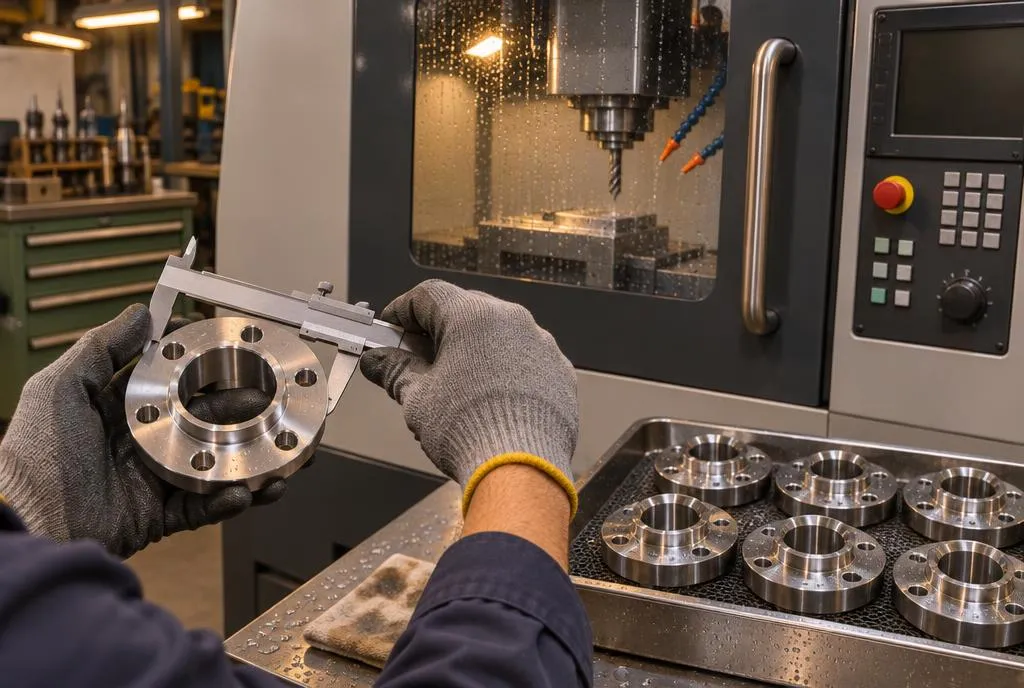
On the CNC side, the part is milled or turned along toolpaths prepared in CAM software. Programming, fixturing and machine setup add time to the first part, but every following part comes off the same program with repeatable results.
Which gives better tolerances and surface finish?
Dimensional accuracy is the main strength of CNC machining. A tolerance is the permitted range by which a dimension may deviate from its nominal value. The comparison published by Hubs gives these typical values:
| Process | Typical tolerance | Minimum wall |
|---|---|---|
| CNC machining | ±0.025 – 0.125 mm | 0.75 mm |
| FDM (desktop) | ±0.5 mm | 0.8 – 1.0 mm |
| FDM (industrial) | ±0.2 mm | 0.8 – 1.0 mm |
| SLS | ±0.3 mm | 0.7 – 1.0 mm |
| SLM / DMLS (metal) | ±0.1 mm | 0.4 mm |
Fictiv gives similar ranges: roughly ±0.025 – 0.13 mm for CNC and roughly ±0.1 – 0.5 mm for 3D printing, depending on the process. These values vary with part size, material and machine, so agree on the drawing tolerances with your manufacturer in advance. For dimensions without an individual tolerance, see which general tolerance class applies in our article on ISO 2768.
Surface finish follows the same pattern. Printed parts show layer lines and a stair-step effect on inclined faces, and FDM and SLA parts carry marks where supports were removed. Machined parts may show tool marks, but the surface is generally smoother, and functional surfaces such as bearing seats, sealing faces and threads can be machined directly.
Is a printed part as strong as a machined one?
A machined part is cut from solid stock, so it has the same mechanical properties in every direction; this is called isotropy. 3D-printed parts are often anisotropic: their strength depends on direction, and they may be weaker along the layer lines. The sources we reviewed agree that layer adhesion affects mechanical properties and that, in high-stress applications, printed parts can fall short of machined metal parts.
In practice, a printed prototype is usually good enough for fit checks, form and ergonomics. If the part will carry load, see vibration or impact, and you are running functional tests, machining it from the real material gives results that transfer more reliably to series production. If you must print, choose the build orientation so that the load does not pull the layers apart.
Which materials can be used?
CNC machining offers a very wide choice: metals such as aluminium, steel, stainless steel, brass, copper and titanium, and engineering plastics such as ABS, POM (Delrin), nylon (PA), polycarbonate, PEEK, PTFE and HDPE. Its key advantage is that the prototype can be made from exactly the material used in production.
For 3D printing, plastics include PLA, ABS, PETG, ASA, nylon, TPU and various resins; metal powders include stainless steel, aluminium, titanium, Inconel and cobalt-chrome. Flexible materials such as TPU and other elastomers are easy to print but difficult to machine. On the other hand, resins sold as "ABS-like" or "PC-like" do not fully match the properties of the material they are named after, so always check the material data sheet.
Quantity and lead time: when does CNC become the better choice?
3D printing needs no mould, fixture or toolpath: the file is prepared and printing starts. The first part therefore comes quickly, and the cost per part stays largely the same as quantity grows. In CNC machining, programming and setup costs fall on the first part; as quantity grows, this fixed cost is spread over more parts and the unit cost drops.
The sources point to roughly the same break-even zone. Hubs states that additive manufacturing is typically more affordable than CNC below 10 units, and that for plastics between 10 and 100 units printing is still favoured but CNC should be considered. Protolabs writes that for 100 or more parts with fairly straightforward geometry CNC would likely be the choice, and that beyond around 500 or 1,000 parts other processes such as injection moulding should be considered. Metal parts are different: from 1 to 10 units printing and CNC compete depending on geometry, and at higher quantities CNC usually leads.
It would be misleading to quote a fixed lead time; queue, part size, material and finishing all play a role. In a sample enclosure comparison, Hubs estimated 1-3 days for desktop FDM and 1-2 weeks for CNC. For simple geometries the gap can close, so lead time should be agreed job by job.
Which should you choose, and when?
| Criterion | 3D printing | CNC machining |
|---|---|---|
| Quantity | 1-10 parts, one-off trials | Tens to hundreds of parts, repeat orders |
| Geometry | Internal channels, lattices, organic shapes | Surfaces the tool can reach; internal corners keep a tool radius |
| Tolerance | About ±0.1 – 0.5 mm (by process) | About ±0.025 – 0.125 mm |
| Strength | Direction-dependent, may be weaker along layers | Same in every direction (isotropic) |
| Surface | Layer lines, support marks | Tool marks, generally smoother |
| Material | Selected plastics, resins, metal powders, flexible materials | The production material itself |
| First part | Little setup, quick start | Requires programming and fixturing |
Keep CNC's geometric limits in mind as well: because cutting tools are round, internal corners cannot be perfectly sharp, deep enclosed cavities the tool cannot reach cannot be machined, and complex parts need several setups. In printing, overhangs require supports in FDM and SLA, while in SLS the surrounding powder supports the part, so none are needed.
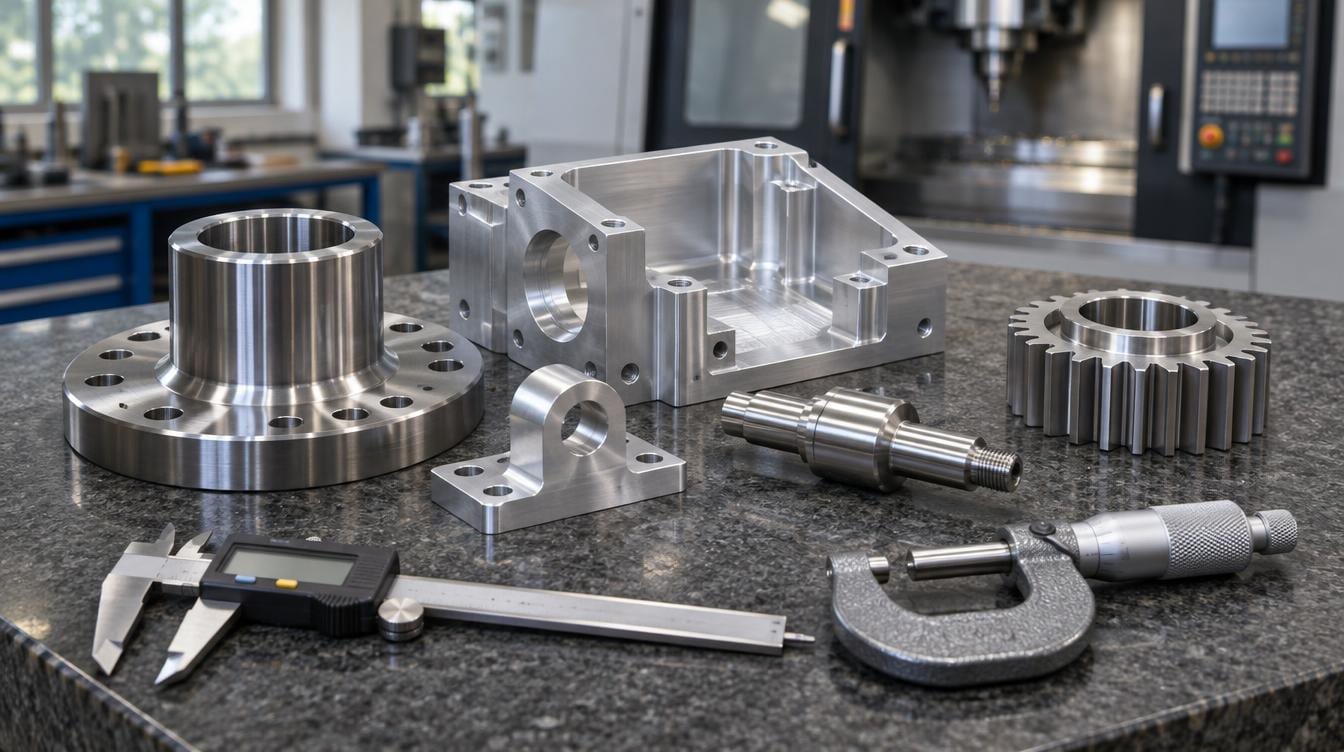
In our workshop we machine prototypes and small batches on CNC vertical machining centres, milling machines and lathes. You can see sample parts on our catalogue page and request a quote with your drawing via the contact page.
Sources
Frequently asked questions
Is 3D printing or CNC machining cheaper for prototypes?
For a few parts, especially plastic parts with complex geometry, 3D printing is usually cheaper; Hubs puts the threshold at around 10 units. As quantity grows, CNC setup costs are spread over more parts and CNC becomes more economical.
Are 3D-printed parts as accurate as CNC parts?
Generally not. Sources give typical tolerances of about ±0.025 – 0.125 mm for CNC and about ±0.1 – 0.5 mm for 3D printing, depending on the process. Tightly toleranced features can be machined after printing.
Why can a printed part be weaker than a machined one?
Printed parts are built in layers, so they are often anisotropic: their strength depends on direction and they may be weaker along the layer lines. A machined part comes from solid stock and has the same properties in every direction.
From what quantity should CNC machining be preferred?
There is no fixed limit; it depends on geometry and material. Protolabs notes that for 100 or more parts with fairly simple geometry CNC is likely the choice, and that beyond around 500 or 1,000 parts processes such as injection moulding should be considered.
Is a printed prototype good enough for functional testing?
It is usually enough for form, dimension and fit checks. For parts working under load, vibration or heat, machining them from the production material gives test results that transfer more reliably to series production.
This article is for general information only. Make decisions on machine selection, safety and design together with the relevant engineer and manufacturer.