MIG vs MAG vs TIG Welding: What Are the Differences?
MIG, MAG and TIG welding differ in electrode, shielding gas, speed and weld quality. This guide explains which process suits which material and thickness, with a comparison table.
What do the three processes have in common?
MIG, MAG and TIG are all gas-shielded arc welding processes. An electric arc between the electrode and the workpiece melts the metal, while shielding gas flowing from the torch protects the molten weld pool from oxygen, nitrogen and moisture in the air. If gas coverage is inadequate, porosity and oxidation appear in the weld.
The processes are identified by reference numbers in ISO 4063. These numbers usually appear on welding procedure specifications (WPS: the document that defines the process, materials and parameters for a weld):
| ISO 4063 no. | Process | In short |
|---|---|---|
| 131 | MIG | Consumable wire electrode, inert gas shield |
| 135 | MAG | Consumable wire electrode, active gas shield |
| 136 | Cored-wire MAG | Tubular cored wire, active gas shield |
| 141 | TIG | Non-consumable tungsten electrode, inert gas shield |
What is the difference between MIG and MAG?
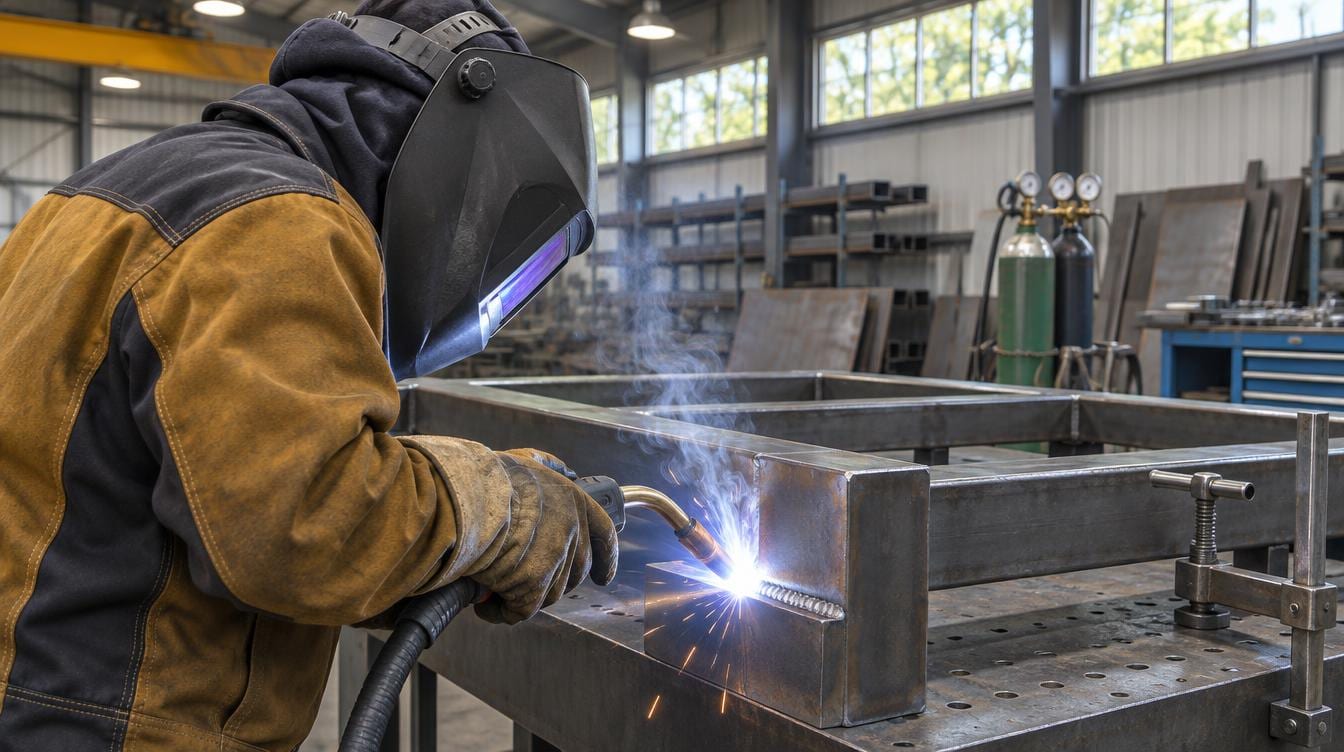
MIG and MAG use the same machine and the same torch. Wire is fed from a spool through a wire feeder to the torch; it carries the arc and melts to fill the joint. The welder works with one hand, which makes the process fast and relatively easy to learn.
The difference lies in how the shielding gas interacts with the weld pool. MIG (metal inert gas) uses gases such as argon that do not react chemically, and is preferred for non-ferrous metals such as aluminium. MAG (metal active gas) uses carbon dioxide (CO2) or argon-CO2 mixtures, which interact with the arc and the pool. According to TWI, it was the development of CO2 shielding that made the process viable for welding carbon steel. A mixture of 75% argon and 25% CO2 is often cited as typical; the right gas depends on the wire, the material and the metal transfer mode.
On the shop floor both are often simply called "MIG". Strictly speaking, gas-shielded welding of carbon steel with an active gas is MAG. Using the correct term in quotations and specifications avoids confusion over gas and wire selection.
How does TIG welding work?
In TIG welding the arc forms between a non-consumable tungsten electrode and the workpiece. The electrode does not become part of the weld; where filler is needed, the welder feeds a separate rod into the pool with the other hand. Current is usually controlled with a foot pedal or a torch-mounted control. Because both hands, and often a foot, work together, TIG demands more skill.
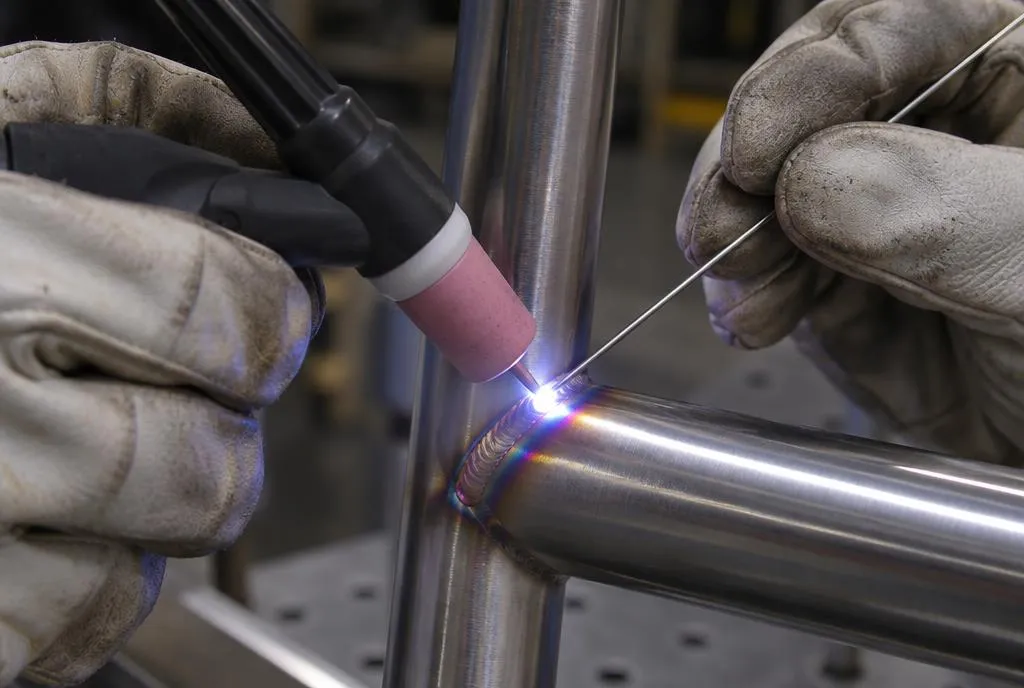
Pure argon is the usual shielding gas. CO2 is not used because it wears the tungsten electrode and contaminates the weld. Argon-helium mixtures may be used on thick aluminium when deeper penetration is needed.
The type of current depends on the material. Steel and stainless steel are welded with direct current (DC). Aluminium and magnesium are welded with alternating current (AC): the oxide layer on aluminium melts at a higher temperature than the base metal, and the cleaning action of AC helps break it up. A shop that works with aluminium therefore needs an AC/DC TIG machine.
TIG produces no spatter, sparks or slag; the weld pool can be controlled precisely and welding is possible in all positions. The trade-off is a low deposition rate, so time and labour cost per weld are higher.
MIG vs MAG vs TIG: where does each one stand out?
The table below shows general tendencies. Every job still needs to be assessed against its material, thickness, welding position and required quality.
| Feature | MIG (131) | MAG (135) | TIG (141) |
|---|---|---|---|
| Electrode | Consumable wire, also the filler | Consumable wire, also the filler | Non-consumable tungsten, separate filler rod |
| Shielding gas | Inert (argon, argon-helium) | Active (CO2, argon-CO2) | Usually pure argon |
| Typical material | Aluminium and other non-ferrous metals | Carbon and low-alloy steel | Stainless, aluminium, copper, titanium |
| Thickness tendency | Medium and thick sections | Medium and thick sections | Thin and delicate parts |
| Welding speed | High | High | Low |
| Spatter | Depends on gas and transfer mode | Depends on gas and transfer mode | None |
| Weld appearance | Good, depends on the welder | Good, may need cleaning | Very clean and even |
| Learning curve | Relatively easy, one hand | Relatively easy, one hand | Difficult, two hands and pedal |
| Cost per weld | Low | Low | High |
Which process for which material and thickness?
The first question is the material; the second is how thick the part is and how visible the weld will be. Exact thickness limits vary with the machine, wire, gas and position, so treat the points below as a starting point.
Carbon steel frames, structures and machine bodies
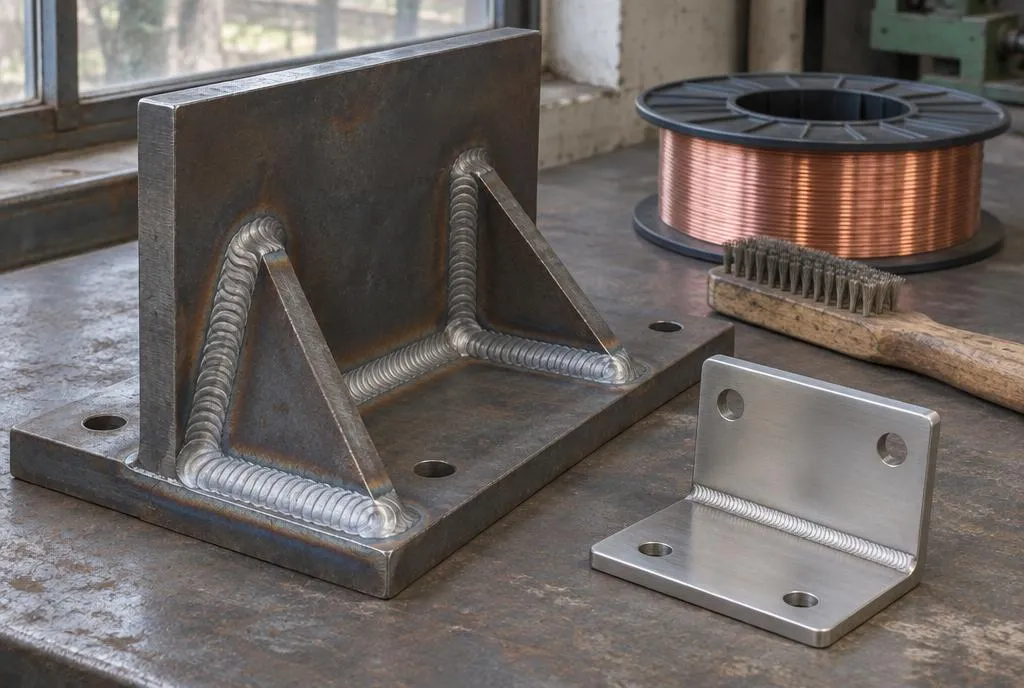
For steel structures with long welds and thick sections, MAG welding stands out for productivity. Press bodies, machine frames and load-bearing structures fall into this group. Welded bodies are often machined afterwards; for that stage, see our article on CNC milling vs CNC turning.
Stainless steel
For thin-walled pipe, food equipment and parts with visible surfaces, TIG gives a clean, controlled weld. On thicker stainless parts and in series work, gas-shielded wire welding is also used with the gas mixtures recommended by the wire and gas suppliers.
Aluminium
AC TIG is the usual choice for thin aluminium and for welds where quality and leak-tightness matter. MIG is used where higher productivity is needed. Miller advises avoiding short-circuit transfer on industrial aluminium applications and using pulsed MIG on thin sheet. With either process, the oxide layer must be removed before welding.
Thin sheet
Thin sheet carries a high risk of burn-through and distortion. TIG has the advantage because it controls heat input precisely; MIG/MAG can also be used with suitable settings.
Is the process the only factor in weld quality?
No. The same process can produce both good and poor welds. The main factors are:
- Surface preparation: removing oil, paint, rust and oxide. On aluminium, brushing with a stainless steel brush after solvent cleaning is recommended.
- Correct choice of wire, gas and parameters: current, voltage, wire feed speed and gas flow rate.
- Undisturbed gas coverage: draughts or wind can blow the gas away and cause porosity.
- The welder's skill and experience with the process.
- Inspection after welding: visual inspection and, where required, non-destructive testing.
Bahar Makina carries out welded fabrication and special-purpose machine manufacturing with gas metal arc welding equipment at its workshop in Bornova, İzmir. You can see examples of our work in the catalogue or reach us through the contact page to discuss your part.
Sources
Frequently asked questions
Can MIG and MAG welding be done on the same machine?
Yes. MIG and MAG use the same machine and torch; what changes is the shielding gas and the wire selected to match it.
Why is CO2 not used in TIG welding?
CO2 wears the tungsten electrode and contaminates the weld. That is why TIG welding usually uses pure argon.
Which process is used to weld aluminium?
AC TIG is used for thin parts and for welds that must be high quality and leak-tight; MIG (pulsed MIG on thin sheet) is used where higher productivity is needed. In both cases the oxide layer must be removed first.
Which process gives the strongest weld?
Weld strength depends as much on the right filler, parameters, surface preparation and welder skill as on the process. TIG gives a more precise and cleaner weld; on thick steel, MAG can also deliver the required result. For critical parts, the procedure should be verified by qualification tests.
What do the numbers 131, 135 and 141 in ISO 4063 mean?
131 denotes MIG, 135 MAG and 141 TIG welding. 136 is tubular cored wire welding with an active gas shield. These numbers are used in welding procedure specifications.
This article is for general information only. Make decisions on machine selection, safety and design together with the relevant engineer and manufacturer.