Blanking, Bending and Progressive Dies: Key Differences
A cutting die shears sheet metal, a bending die forms it without cutting, and a progressive die performs several operations in sequence on a strip. We explain which suits which part and volume, and the main components of a die.
What does a sheet metal die do, and what types are there?
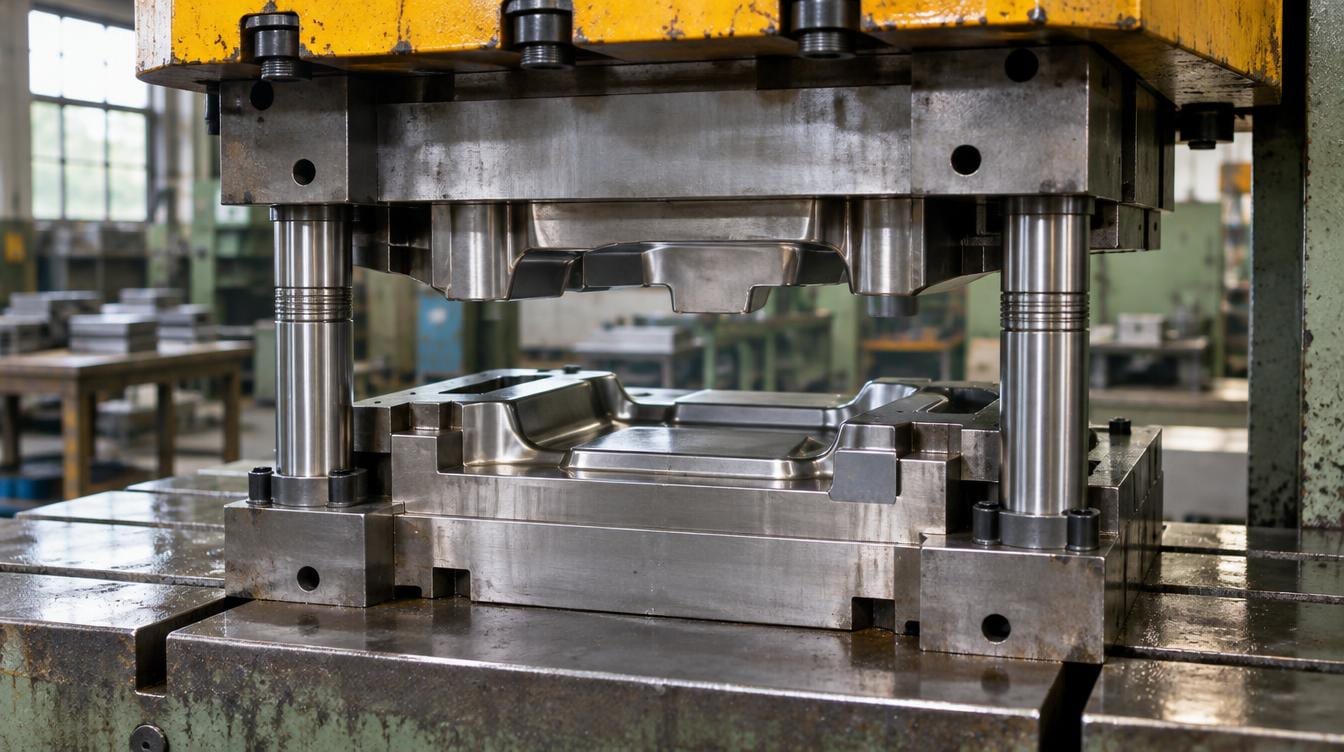
A sheet metal die is a part-specific tool that works in a press and brings the sheet to a defined shape. It has two halves: the upper half, mounted on the press ram, carries the punch; the lower half, mounted on the press bed, carries the die. When the punch comes down, the sheet is either cut or formed.
It helps to classify dies in two ways. The first is the operation: cutting (blanking and piercing), bending, drawing. The second is how many operations happen per press stroke and how the part moves through the tool: single-operation die, compound die, progressive die and transfer die. So "cutting die" describes the operation, while "progressive die" describes the working arrangement; a progressive die can contain both cutting and bending stations.
How does a cutting die work?
In a cutting die, the sharp edges of the punch and the die separate the sheet along a contour. There are two basic operations:
- Blanking: the piece you cut out is the part, and the remaining sheet is scrap. Example: the outer contour of a washer or flange.
- Piercing: the piece you cut out is scrap, and the sheet with the hole is the part. Example: mounting holes in a bracket.
The most important setting for cut quality is the cutting clearance, the distance between the cutting edge of the punch and that of the die. Lecture notes from Istanbul Technical University (ITU) give typical values of about 4% to 8% of sheet thickness, with the exact value chosen by material type. If the clearance is too small, the cutting force rises and the cut edge shows an irregular double fracture line; if it is too large, the sheet bends between the cutting edges and burrs increase.
Where the clearance goes depends on the operation. In blanking, the die opening sets the part size and the clearance is taken off the punch. In piercing, the punch sets the hole size and the clearance is added to the die. A small angular clearance is also ground below the die opening, so that the blank or slug drops through without jamming.
How does a bending die work?
A bending die does not cut the sheet; it permanently bends it about a straight axis. Two methods are most common in the shop:
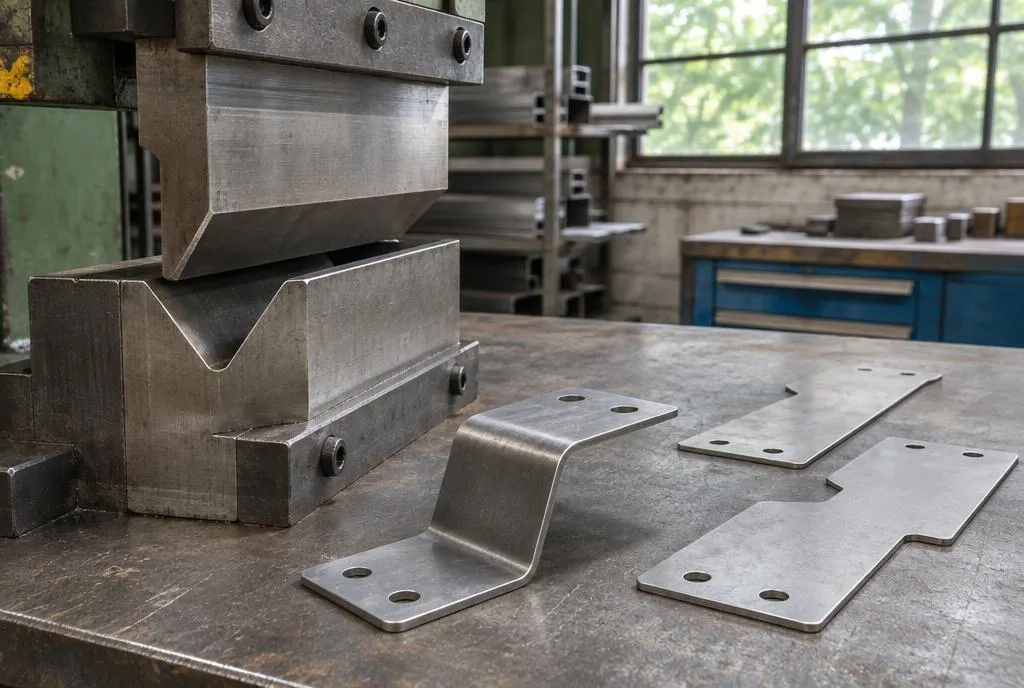
- V-bending: the punch presses the sheet into a V-shaped die. It is usually done on a press brake. V-dies are simple, relatively inexpensive and reusable across different parts, which makes them a good fit for low volumes.
- Edge (wiping) bending: the sheet is clamped firmly by a pressure pad, and the punch bends the free edge downward. These dies are more complex and more expensive, but in high-volume production they bend every part the same way.
One effect you must allow for is springback: after the punch retracts, the elastic energy left in the sheet opens the bend slightly, so the part angle differs from the die angle. Springback depends on material, thickness and bend radius. Toolmakers compensate by designing the die to overbend slightly or by correcting it after tryout. Bend allowance is also calculated at the design stage so that the flat blank length comes out right.
What is a progressive die, and when is it the right choice?
In a progressive die, the sheet enters as a strip unwound from a coil and advances one step with each press stroke. Inside the die there is a sequence of stations, each doing one or more operations: piercing, notching, bending, embossing. The part stays attached to the strip up to the last station, where it is cut off. The rest of the strip leaves as scrap.
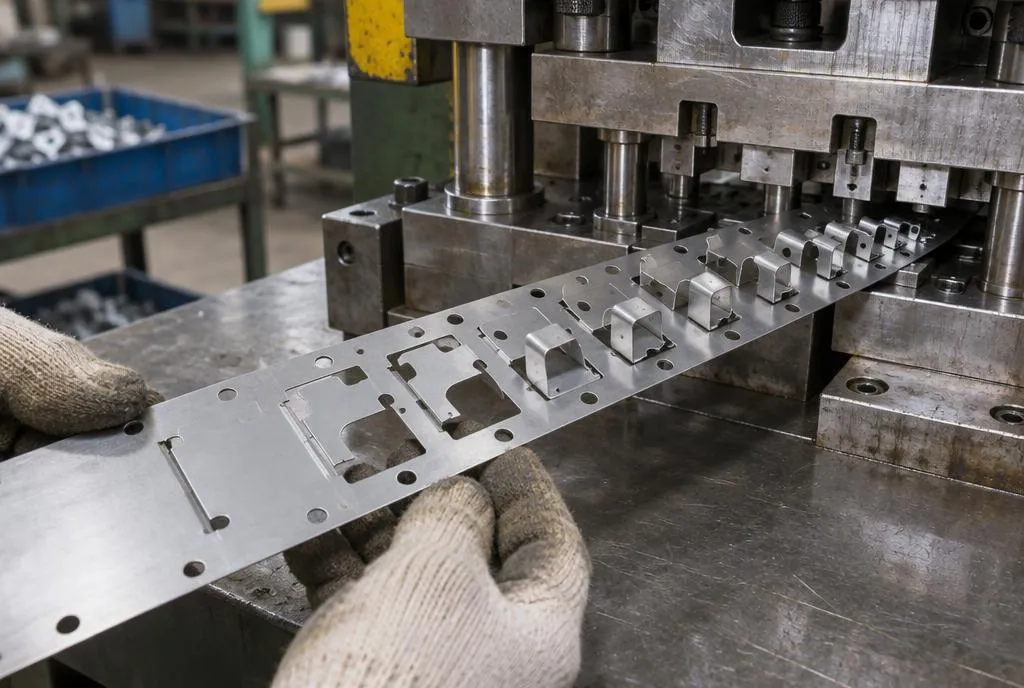
The strip has to land in exactly the right place at every step. Because the feeder alone cannot achieve that precision, the die uses pilots, pins with a conical tip that enter holes pierced in the first stations and locate the strip on every stroke.
The advantage is speed: the press delivers a finished part on every stroke, with no handling or re-clamping in between. There is a price. Because the die is built as a single block, design and manufacture take longer and cost more. Extra material is needed in the strip to carry the parts, which increases scrap. Operations that require the part to leave the strip, such as deep drawing, are difficult in a progressive die.
Where do compound and transfer dies fit in?
A compound die cuts the inner and outer contours of a part in a single press stroke. For flat parts with holes, such as washers and gaskets, this gives good positional accuracy between the hole and the outer edge, and the die is simpler than a progressive die.
A transfer die also has a sequence of stations, but the part is separated from the strip early and moved between stations by a transfer system such as mechanical fingers. This arrangement is used for deep-drawn parts or parts too large to be carried in a strip.
Which die for which part and volume?
There is no fixed quantity threshold; the decision depends on part geometry, tolerances, material, annual volume and how long the part will stay in production. The general pattern is:
| Die type | Operations per stroke | Suitable parts | Suitable volume | Tooling cost and lead time |
|---|---|---|---|---|
| Single-operation cutting die | One cut | Simple contour or hole | Low to medium | Low |
| V-bending (press brake) | One bend | Brackets, profiles, box edges | Low, prototypes | Low; tooling reused across jobs |
| Edge bending die | One or more bends | Parts with a repeated bend | Medium to high | Medium |
| Compound die | Inner and outer cut together | Washers, gaskets, flat parts with holes | Medium to high | Medium |
| Progressive die | One operation per station, one part per stroke | Small and medium parts with holes and bends | High | High; long design time |
| Transfer die | Part moved between stations | Large or deep-drawn parts | High | High |
For low volumes, or a part whose design is not yet frozen, single-operation dies and press brake bending usually make more sense; if the design changes, your loss is small. Once the part is stable and volumes grow, the same operations can be combined in a progressive die. Press selection matters as much as the die; we covered it in our article on hydraulic vs mechanical eccentric presses.
What are the main components of a die?
Whatever the die type, most press dies are built from similar components:
- Upper and lower die shoes: flat, parallel plates on which all other components are mounted.
- Guide pins and bushings: make the two halves close in the same relative position on every stroke. Maintaining the cutting clearance depends largely on them.
- Shank: connects the upper half to the press ram; it should sit close to the centre of gravity of the plate.
- Punch plate and punches: hold the cutting, piercing or bending punches in place.
- Die block: the lower element that the punch enters and that gives the part its shape.
- Stripper plate: strips the sheet off the punch as it withdraws. It can be fixed or spring-loaded; a spring-loaded stripper also holds the sheet down.
- Stock guides and stops: make the sheet enter in the same position every time.
- Pilots: locate the strip precisely at each step in progressive dies.
- Stop (setting) blocks: limit how far the punch enters the die.
At our workshop in Bornova, Izmir, we manufacture presses and dies and do sheet metal bending work. To discuss which die arrangement suits your part drawing, please get in touch through our contact page.
Sources
Frequently asked questions
Is a cutting die the same as a progressive die?
No. A cutting die describes the operation, while a progressive die describes the working arrangement. A progressive die can contain cutting, piercing and bending stations together.
How large should the cutting clearance be?
ITU lecture notes give typical values of about 4% to 8% of sheet thickness, with the exact value chosen by material type. Too little clearance raises the force; too much produces burrs.
Does a progressive die make sense for low volumes?
Usually not. Progressive dies take long to design and cost more. For low volumes, single-operation dies and press brake bending are more flexible; you can move to a progressive die once the design is stable and volumes grow.
Why does a bent part come out at a different angle from the die?
Because of springback. When the punch retracts, elastic energy in the sheet opens the bend slightly. The die is designed to compensate, or corrected after tryout.
What is a pilot in a progressive die?
A pilot is a pin with a conical tip that enters holes previously pierced in the strip. It adds the precision the feeder cannot provide and locates the strip correctly on every stroke.
This article is for general information only. Make decisions on machine selection, safety and design together with the relevant engineer and manufacturer.