Hydraulic vs Mechanical Eccentric Press: Which for Which Job?
An eccentric press is fast and reaches full tonnage near bottom dead center; a hydraulic press is slower but delivers full force anywhere in the stroke. Here is how to choose, starting from how each machine works.
How do eccentric and hydraulic presses work?
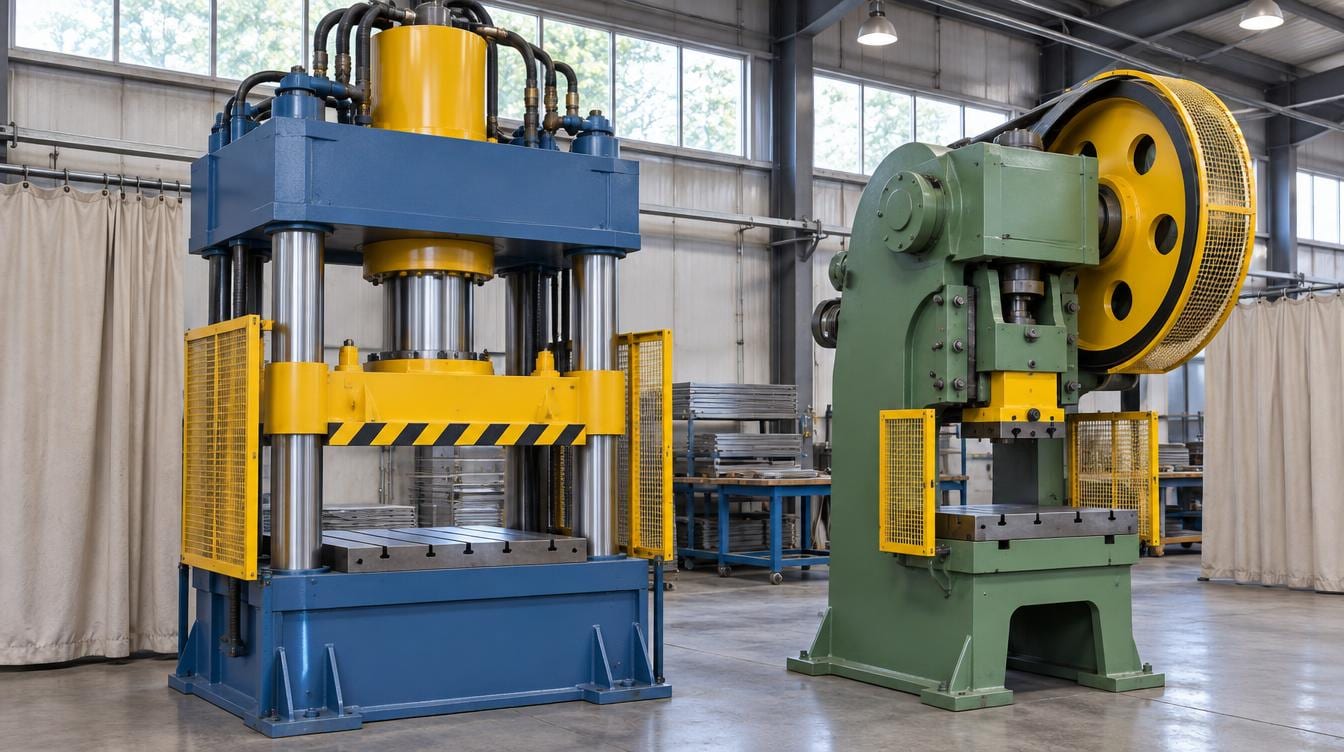
An eccentric press is a mechanical press. An electric motor drives a heavy flywheel that stores energy. When the clutch engages, that energy passes to an eccentric shaft or crankshaft, and a connecting rod turns the rotation into the up-and-down motion of the slide (ram). The slide follows the same path every cycle: the stroke length is set by the shaft geometry and is fixed.
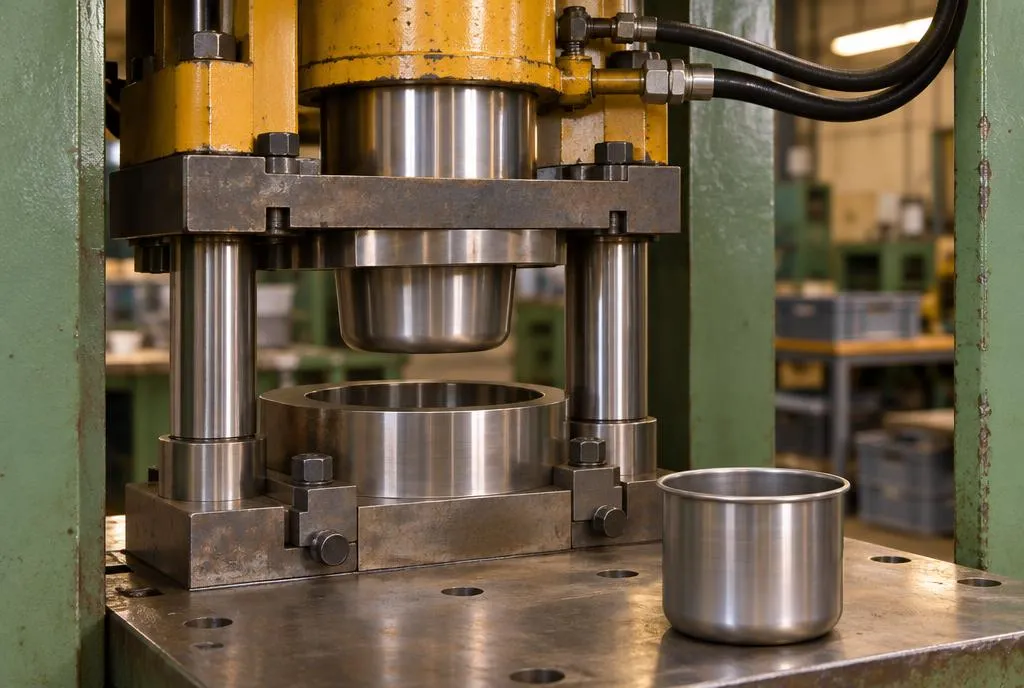
In a hydraulic press the force comes from one or more hydraulic cylinders. A pump delivers oil to the cylinder. In a closed system the pressure is the same everywhere (Pascal's principle), and pressure multiplied by piston area gives the ram force. How far the ram travels, how fast it moves and at what pressure it returns are set with valves, limit switches and pressure transducers.
This basic difference explains why the two machines behave so differently in force, speed and flexibility.
How does force change over the stroke?
The most common mistake in press selection is assuming that the tonnage on the nameplates of the two machines means the same thing.
A mechanical press reaches its rated force (tonnage) only in a zone close to bottom dead center, the lowest position of the slide in the stroke. Higher up, the crank mechanism has less mechanical advantage and the available force drops. This is why mechanical press builders publish a tonnage curve showing how force varies with slide position.
A mechanical press has a second limit as well: flywheel energy. The working energy depends on the mass and speed of the flywheel. A job that needs force over a long distance can use up the flywheel energy even when the tonnage looks sufficient. Tonnage and energy must be checked separately.
A hydraulic press, by contrast, can deliver full force at any point in the stroke and at any speed. For a long forming operation that starts early in the stroke, this is a major advantage. The ram can also be held at the set pressure for a defined time. This is called dwell, and it helps the material settle fully into the die or supports moulding operations.
How do speed, stroke and accuracy compare?
On a mechanical press the velocity profile of the slide within one cycle is fixed: it starts at zero at top dead center, peaks around mid-stroke and returns to zero at bottom dead center. The stroking rate can be changed, but the shape of the profile cannot. In general, mechanical presses reach the highest stroking rates and offer high repeatability. On a hydraulic press the ram speed can be varied even within a single cycle, for example fast approach, slow pressing and fast return. Hydraulic presses are, however, generally slower.
| Feature | Eccentric (mechanical) press | Hydraulic press |
|---|---|---|
| Drive | Motor, flywheel, eccentric/crankshaft | Pump, valves, hydraulic cylinder |
| Stroke length | Fixed | Adjustable |
| Full force | Near bottom dead center | Anywhere in the stroke |
| Slide velocity profile | Fixed within a cycle | Adjustable within a cycle |
| Operating speed | Generally the highest | Generally lower |
| Dwell under pressure | No | Yes |
| Repeatability | Generally high | Generally lower than a mechanical press |
| Typical work | High-volume blanking, piercing, shallow forming | Deep drawing, complex shapes, straightening, press-fitting |
The table shows general tendencies. Even two machines of the same type can differ depending on design, control system and maintenance condition; for exact figures, refer to the machine's own technical documentation.
Which press suits which job?
The key question is where in the stroke the force is needed and over what distance. Part volume and die type also affect the decision.
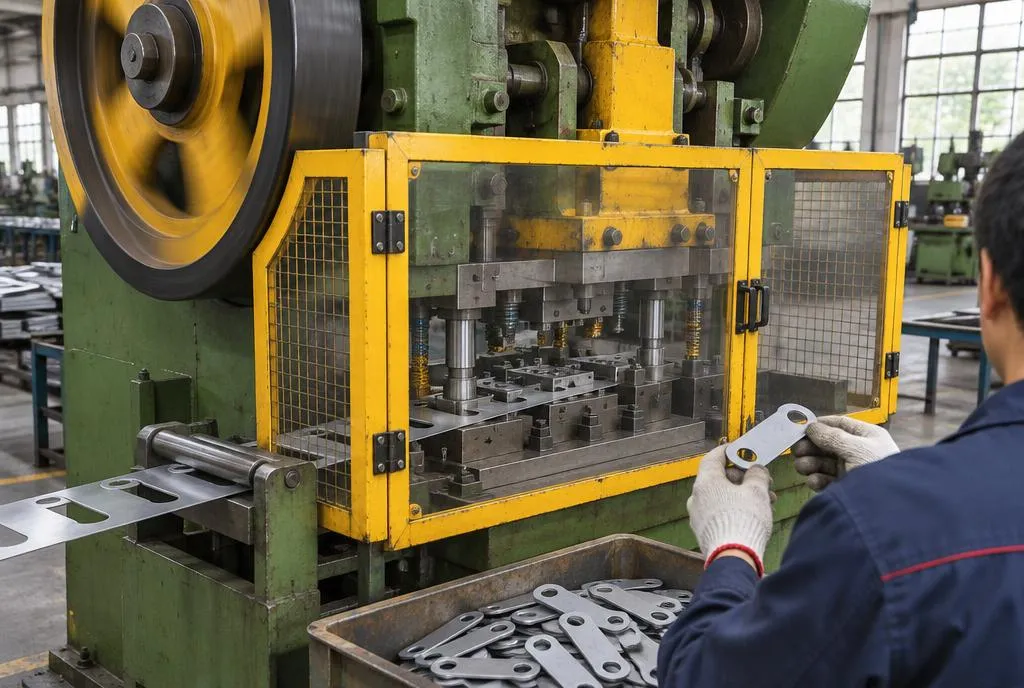
Blanking and piercing
In blanking and piercing, force is needed over a short distance close to bottom dead center, which is exactly where a mechanical press is strongest. For high-volume work with progressive dies, the speed and repeatability of an eccentric press stand out.
Deep drawing and complex forming
In deep drawing, where cups, boxes or cylinders are formed from flat sheet, force is needed over a long distance and the material flow calls for controlled speed. A hydraulic press, with full force at every point, adjustable speed and dwell, suits this kind of work.
Bending, straightening, press-fitting and die tryout
For straightening, pressing in bearings or bushings, compacting and die tryout, being able to adjust stroke and force each time matters. For this kind of varied work a hydraulic press is more flexible. If you want to know how die components are machined, see our article on CNC milling vs CNC turning.
What should you watch for in overload, maintenance and safety?
On a mechanical press, if the force and energy required by the die are miscalculated, for example if full force is demanded too far above bottom dead center, the shaft and frame are overstressed. Stay within the builder's tonnage curve and energy limit. Maintenance focuses on the clutch-brake unit, lubrication and flywheel bearings.
On a hydraulic press the maximum pressure can be set, and a pressure transducer can return the ram once the set value is reached. This makes it easier to limit force. Oil cleanliness, filters, hoses and seals should be checked regularly.
In Europe, safety requirements for presses are collected in the EN ISO 16092 series. Part 1 covers requirements common to all presses, Part 2 covers mechanical presses (presses with part-revolution clutches and servo-driven mechanical presses), and Part 3 covers hydraulic presses that work cold metal. These parts replaced the earlier EN 692 (mechanical presses) and EN 693 (hydraulic presses). Safeguards such as two-hand controls and light curtains are used to stop the press from operating while the operator's hands are in the die area.
Where does a servo press fit in?
Servo presses replace the flywheel and clutch with a powerful servo motor. Because the slide motion is programmable, they offer flexibility in speed and dwell that comes close to a hydraulic press. But they are still mechanical presses at heart, so they reach full force near bottom dead center. EN ISO 16092-2 also covers servo-driven mechanical presses under the mechanical press part.
What questions should you answer before choosing?
Before buying a press or choosing one for a job, answering these questions makes the decision easier:
- Where in the stroke, and over what distance, is force needed?
- What is the part volume and the target cycle time?
- What is the die type: single-station, progressive or deep drawing?
- Is dwell under pressure or speed control required?
- Will the same machine be used for different jobs?
- Is your maintenance team more experienced with mechanical or hydraulic systems?
You can see examples of our press and die manufacturing in the catalogue, and reach us through the contact page about a press or die for your application.
Sources
- EVS-EN ISO 16092-2:2020 – Machine tools safety, Presses, Part 2: Safety requirements for mechanical presses
- EVS-EN ISO 16092-3:2018 – Machine tools safety, Presses, Part 3: Safety requirements for hydraulic presses
- Stamtec – Mechanical vs Hydraulic vs Servo Presses
- Beckwood – Hydraulic Presses: Anatomy and Terminology
- Wikipedia – Machine press
Frequently asked questions
What is the main difference between an eccentric press and a hydraulic press?
An eccentric press generates force through a flywheel and eccentric shaft with a fixed stroke, and reaches full force near bottom dead center. A hydraulic press generates force with a hydraulic cylinder; stroke and pressure are adjustable and full force is available anywhere in the stroke.
Which press is faster?
In general, mechanical eccentric presses reach higher stroking rates. Hydraulic presses are usually slower, but their ram speed can be varied even within a single cycle.
Which press is better for deep drawing?
Deep drawing needs force over a long distance at a controlled speed, so a hydraulic press suits most deep drawing work. Dwell under pressure also helps the material settle into the die.
Which is preferred for blanking and piercing?
Blanking and piercing need force over a short distance near bottom dead center. In high-volume work, the speed and repeatability of an eccentric press are usually an advantage.
Which safety standards apply to presses?
In Europe the EN ISO 16092 series applies: Part 1 covers common requirements, Part 2 mechanical presses and Part 3 hydraulic presses. For specific conformity questions, consult a safety professional and an authorised body.
Can a servo press replace a hydraulic press?
A servo press adds flexibility through programmable slide motion, but it is mechanical at heart and reaches full force near bottom dead center. Where full force is needed early in the stroke, a hydraulic press still has the advantage.
This article is for general information only. Make decisions on machine selection, safety and design together with the relevant engineer and manufacturer.