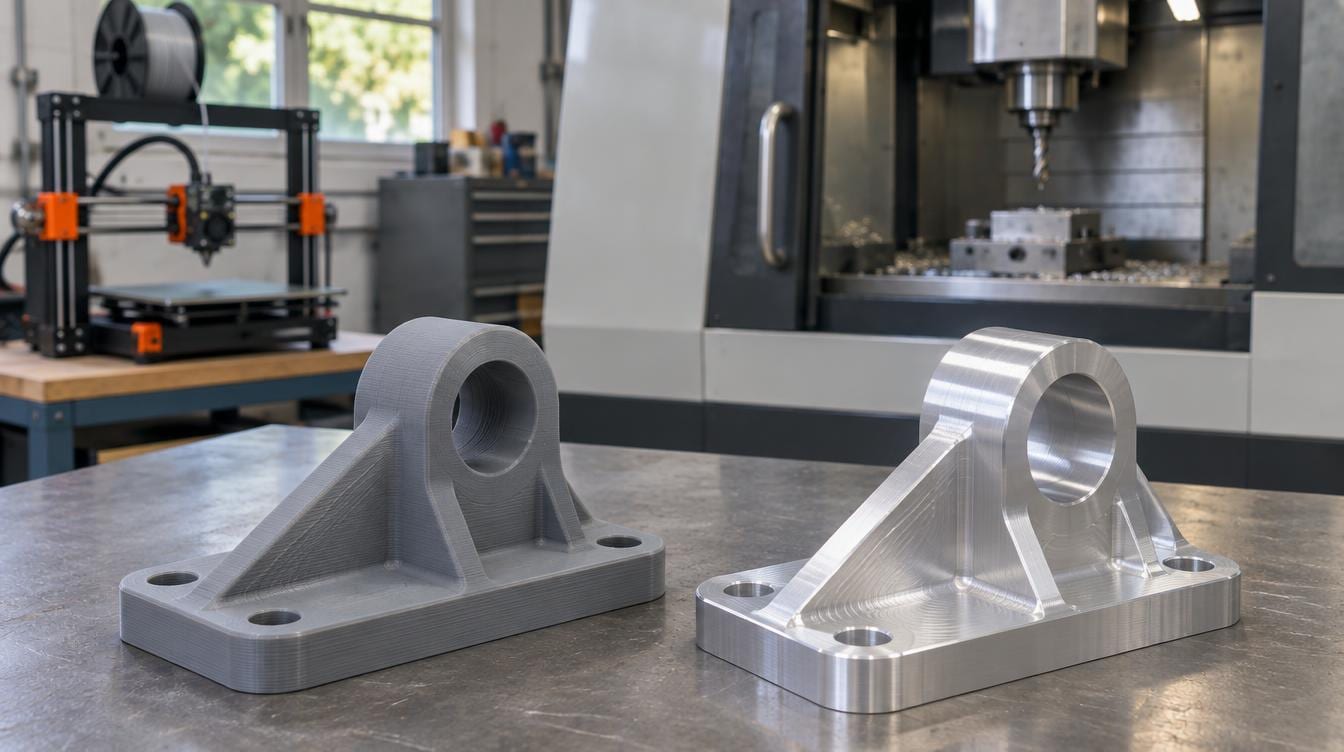
What Is Metal 3D Printing? SLM, DMLS and DED Explained
How powder bed fusion (SLM/DMLS) and directed energy deposition (DED) work, which metals can be printed, and where metal 3D printing makes sense and where it does not.
What exactly is metal 3D printing?
Additive manufacturing builds a part by adding material rather than removing it, the opposite of machining. The 3D model is sliced into thin layers, and the machine builds those layers one after another from the bottom up. For metals, the heat source is a laser, an electron beam or a welding arc.
ISO/ASTM 52900, the standard that defines additive manufacturing terminology, divides the processes into seven categories. Two of them dominate industrial metal part production:
- Powder bed fusion (PBF): a thin layer of powder is spread and the heat source melts only the area that belongs to the part in that layer.
- Directed energy deposition (DED): focused thermal energy melts the material as it is deposited; powder or wire is fed through a nozzle into the melt pool.
SLM and DMLS are not category names in the standard. Both are widely used names for the laser variant of powder bed fusion.
Is there a difference between SLM and DMLS?
In practice, both describe the same process family. SLM (selective laser melting) and DMLS (direct metal laser sintering) come from terms used by different machine builders. Today both are grouped under laser powder bed fusion (L-PBF).
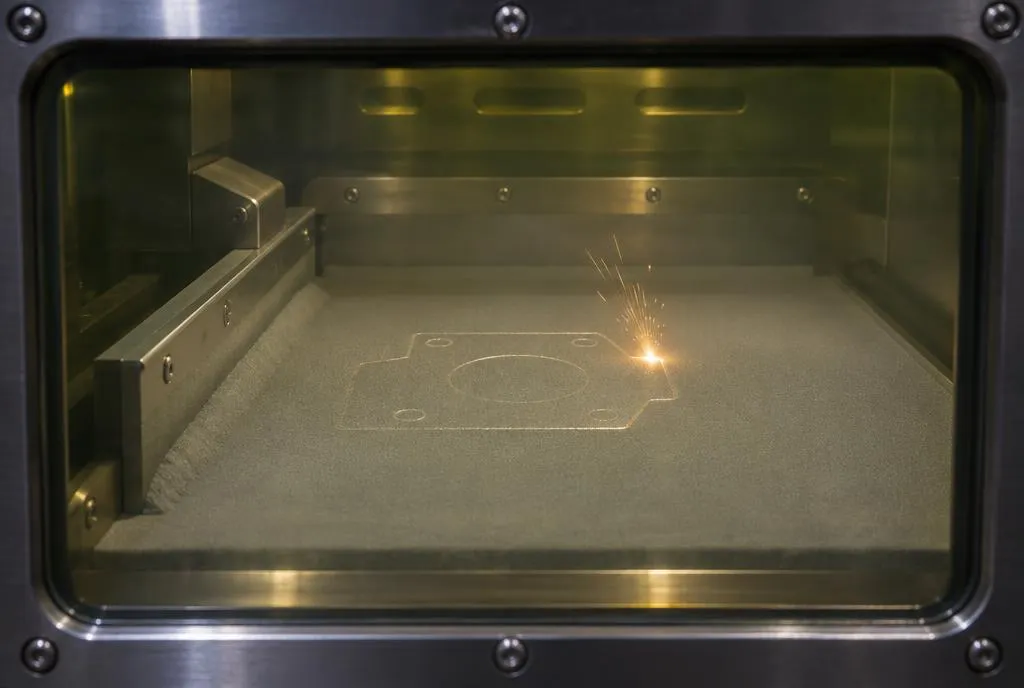
The word "sintering" can be misleading. Sintering means powder particles bond at their surfaces without fully melting. Modern L-PBF machines, however, melt the powder on the build plate to produce a dense metal part. When you read a quote or a technical specification, it is more useful to treat SLM, DMLS and L-PBF as the same method and look for the real differences in the machine, the material and the process parameters.
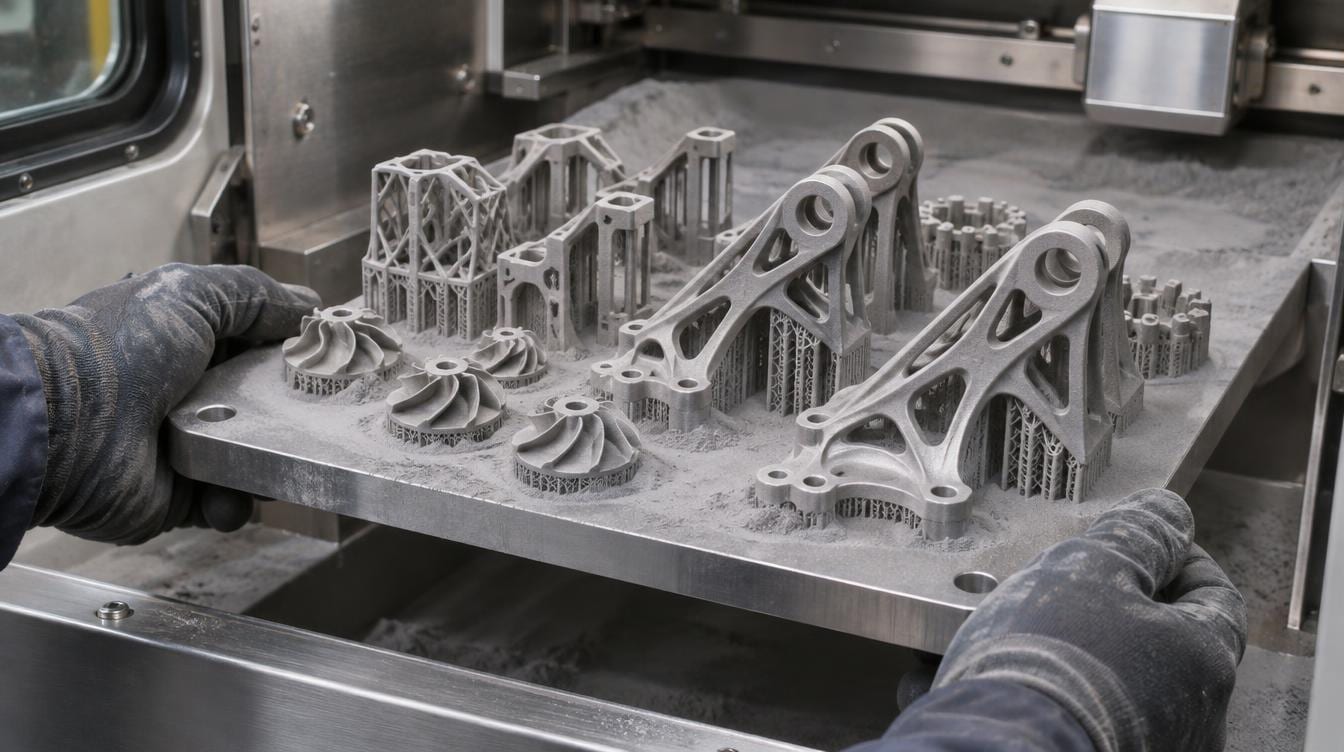
How is a part built in the powder bed?
- A thin layer of metal powder is spread over the build plate. Layer thickness is typically in the 20-80 µm range and is chosen according to the material and the machine.
- The laser scans the cross-section of that layer and melts the powder, fusing it to the layer below.
- The plate drops by one layer thickness, fresh powder is spread and the cycle repeats.
- When the build is complete, the part is taken out of the powder, separated from the plate and its supports are removed. Unmelted powder can be sieved and reused.
The process runs in a closed chamber protected by inert gas so that the hot metal does not oxidise. Powder bed machines that use an electron beam instead of a laser are also on the market.
Why are support structures needed?
The melted zone cools very quickly. This rapid cooling creates residual stress (stress locked inside the material without any external load) and can make edges curl upwards. Supports anchor the part to the plate, conduct heat away and hold the part against the force of the recoater blade that spreads the powder. A common rule in design guides is that surfaces facing the build plate at an angle of less than 45° to the horizontal need support. Supports are later cut off or machined away, so reducing them at the design stage directly cuts time and cost.
How does DED work and where is it used?
In DED, a heat source (a laser, an electron beam or a welding arc such as plasma, TIG or MIG) is directed at a substrate or an existing part. The feedstock, powder or wire, melts in this pool and is deposited layer by layer. The principle resembles weld cladding; the difference is that the motion is CNC or robot controlled and follows a 3D model.
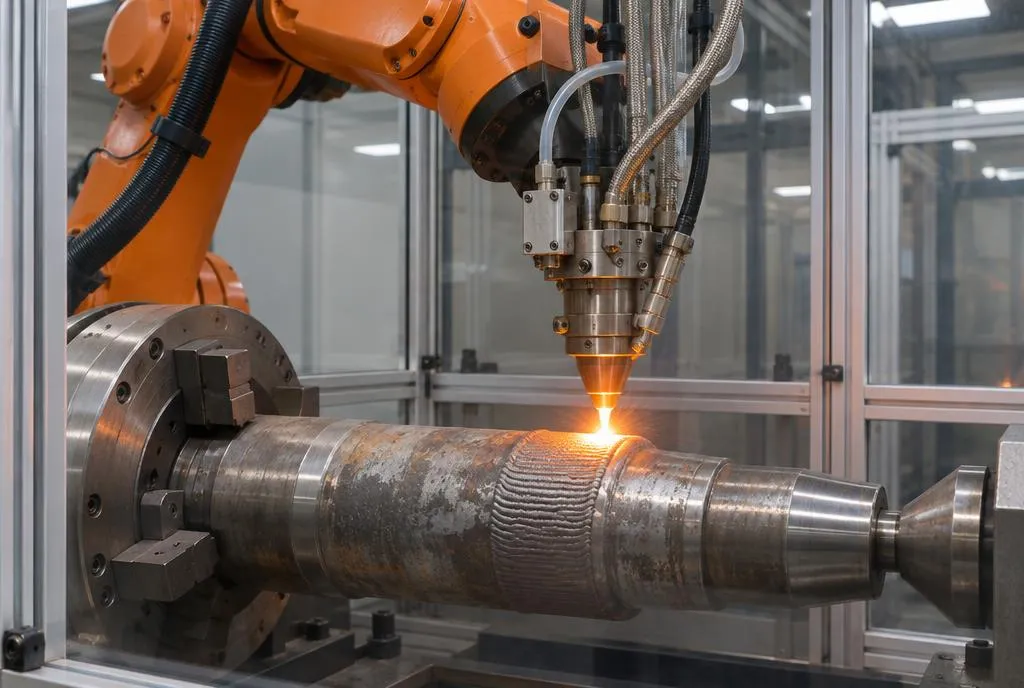
Where DED is strong:
- Large parts: it is not limited by the size of a powder bed chamber. The maker of one electron beam, wire-fed system quotes part sizes measured in metres.
- High deposition rate: wire-fed systems in particular can deposit metal at rates measured in kilograms per hour.
- Repair and remanufacturing: material can be added to a worn shaft, die or housing and then remachined.
- Near-net-shape preforms: the part is deposited close to its final shape and then finished by machining.
The trade-off is that a DED part is not as precise as a powder bed part in fine detail, and machining allowance is left to bring surfaces to final size. Electron beam systems work in a vacuum and need no separate shielding gas; in laser and arc systems the melt pool is protected by shielding gas.
Which metals can be printed?
The most common material families for powder bed fusion are stainless steels, maraging (age-hardening) tool steels, titanium alloys (e.g. Ti6Al4V), nickel-based superalloys (e.g. Inconel 718) and aluminium alloys (e.g. AlSi10Mg). Machine builders define separate process parameters and layer thicknesses for each material.
For wire-fed DED the rule is simpler: metals that are weldable and available as wire are suitable. Manufacturer lists include titanium alloys, Inconel 718 and 625, 300 series stainless steels and 4340 steel.
The same alloy does not give the same properties on a different machine or with different parameters. Take mechanical values from the data sheet the machine and powder supplier publishes for that material and parameter set.
| Feature | Laser powder bed (SLM/DMLS) | DED |
|---|---|---|
| Feedstock | Fine metal powder, spread layer by layer | Powder or wire, fed through a nozzle into the melt pool |
| Heat source | Laser (electron beam variants exist) | Laser, electron beam or welding arc |
| Part size | Limited by the machine chamber | Suitable for very large parts |
| Detail | Fine detail and internal channels possible | Near-net shape, rough surface |
| Build speed | Relatively slow | High deposition rate |
| Typical use | Complex small and medium parts | Large preforms, repair and remanufacturing |
What happens to the part after printing?
A metal part straight from the machine is rarely used as is. Typical finishing steps are:
- Stress relief and heat treatment: to reduce residual stress and obtain the required mechanical properties.
- HIP (hot isostatic pressing): high temperature and pressure to reduce internal porosity; preferred for critical parts.
- Plate separation and support removal: by cutting and machining.
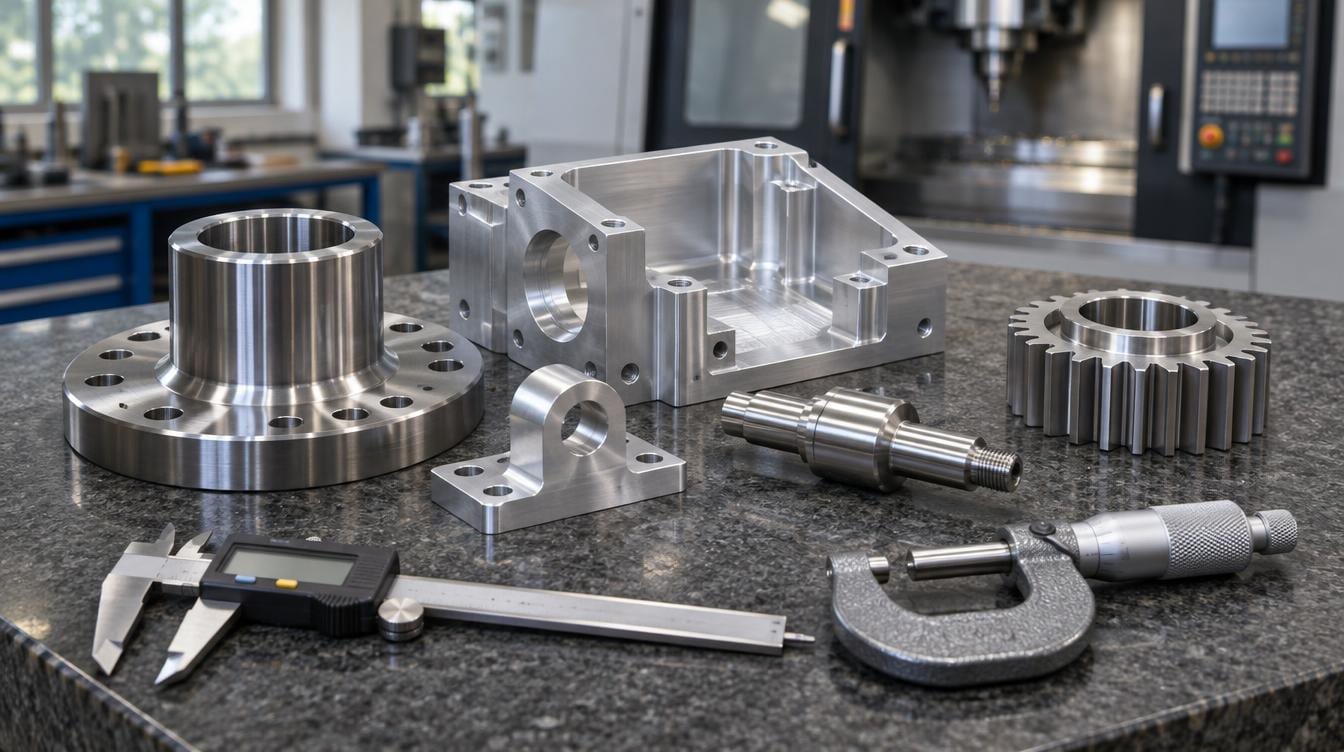
- Machining: precise features such as bearing seats, threads and sealing faces are finished on a CNC machine.
- Inspection: dimensional checks and, where needed, non-destructive testing.
We explain which surface goes on which machine in our article CNC milling vs CNC turning.
When does metal 3D printing make sense?
Metal 3D printing pays off most for internal channels and complex geometries that cannot be machined or cast, for consolidating several parts into one, for weight reduction, for low-volume production without tooling, for fast prototypes and for hard-to-source spare parts.
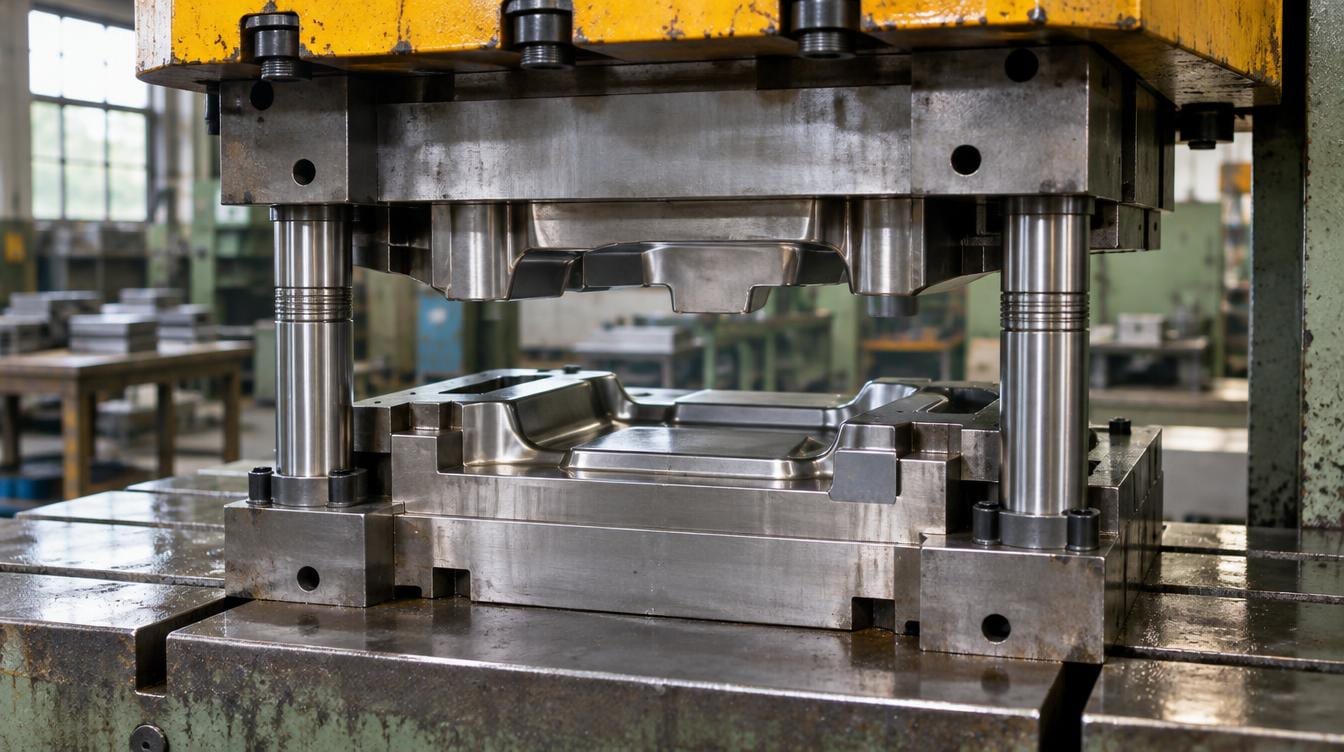
Its limits are equally clear: cost per part may not compete with machining, casting or pressing at high volumes; part size is limited by the chamber; the surface is rough and precise faces must be machined; residual stress and porosity must be controlled. A simple, prismatic, high-volume part is often cheaper on a CNC machine or with a press and die. The decision should weigh geometry, quantity, material and finishing needs together.
To compare post-print machining with producing the same part entirely by CNC, you can send your drawing through our contact page. You can see examples of our work in the catalogue.
Sources
Frequently asked questions
Are SLM and DMLS the same thing?
In practice, yes. Both are trade and historical names for laser powder bed fusion (L-PBF), in which a laser melts metal powder layer by layer. The real differences lie in the machine, the material and the process parameters.
What is DED suitable for?
Large parts, near-net-shape preforms and the repair of worn components. Deposition rates are high but the surface is rough, so the part is usually finished by machining.
What layer thickness is used in powder bed fusion?
Typically 20-80 µm. The value depends on the material and the machine; use the parameters the machine builder defines for that material.
Can a metal 3D printed part be used straight from the machine?
Usually not. It needs stress relief or heat treatment, support removal, machining of precise surfaces and inspection. HIP may be applied to critical parts to reduce porosity.
Will metal 3D printing replace CNC machining?
No, in most cases it complements it. It is strong for complex internal geometries and low volumes; simple, high-volume parts are usually cheaper on a CNC machine or with a press and die.
This article is for general information only. Make decisions on machine selection, safety and design together with the relevant engineer and manufacturer.